Saturday, March 15, 2008

Lon Po Po: A Red-Riding Hood Story From China


Author/Illustrator: Young, Ed
Publisher and Date: Philomel Books, 1989
Genre: Traditional Literature, Picture Book
Age Range: 2nd - 5th grades
Awards: Caldecott Award Winner 1990

Summary: In this version of Red-Riding Hood, three sisters are left at home alone one night while their mother left to go see their grandmother, Po Po, on her birthday. An old wolf disguises himself as Po Po after the mother leaves and is let into the house by the two younger sisters. The oldest sees the wolf's face and comes up with a plan involving the ginkgo tree to kill the wolf so they will be safe again.

Response: I really enjoyed this version of Red-Riding Hood. It is so different but still shares some similarities with the one I heard when I was growing up. In this one the "grandmother" comes to the house instead of being sick in bed and it has three little girls instead of one in a red cape. I liked how the three girls outsmarted the wolf on their own by dropping him in the basket from the tree. It was a clever plan that did not need the assistance of a woodsman passing by!
The girls tell the wolf that if he eats one gingko nut, that he will live forever. I wasn't sure what that was so I looked it up and it is linked above. According to Wikipedia it is misspelled, but I doubt it makes too much of a difference. On that linked site it shows pictures of the ginkgo trees which usually range from 66-115 feet. That wolf had three pretty hard falls from a tree that tall! There is some truth to living forever though, as the nuts are believed to have health benefits in the Chinese culture.

Teaching Ideas: This is a great book to compare cultures with. Elements such as the ginkgo nuts and 'Po Po' could be discussed and students could relate them to a similar item in their culture. A Venn-Diagram could also be created comparing this version with the traditional story of Red-Riding Hood. As a language arts lesson, students could get into small groups to create their own version of Red-Riding Hood and share it with the class.

Swamp Angel


Author: Isaacs, Anne
Illustrator: Zelinksy, Paul O.
Publisher and Date: Dutton Children's Books, 1994
Genre: Traditional Literature, Picture Book
Age Range: 1st - 4th grades
Awards: Caldecott Honor 1995

Summary:
Angelica Longrider, also known as Swamp Angel, was a large girl from birth. She came to the recuse of many people in Tennessee when they needed help. One summer she wrestled with a bear named Thudering Tarnation in order to help with the winter supplies of the settlers in Tennessee. After Angel managed to kill the bear, all the people in Tennessee were fed and the leftovers were stored up just in time for winter.

Response: What I liked most and noticed first about the book were the illustrations. They are oil paintings on cherry, maple, and birch veneers. Zelinsky was creative with it and came up with a style that fit the story of Swamp Angel. It takes place in Tennessee where the people are settling the area. It makes me picture open fields surrounded by woods with a line of log houses, so it makes sense to me for the pictures to be painted on wood.
The big bear constellation is explained by Swamp Angel throwing the bear up so high into the sky. The reader later learns that the bear crashed into a pile of stars, making an impression in them. Ursa Major is the true name of it and the Big Dipper is part of it.
I really liked how the Great Smoky Mountains came about according to this story. I think it is something children in this area especially would be able to relate to well. A lot of people visit them frequently or have even lived there so they would know what they look like, having been there.
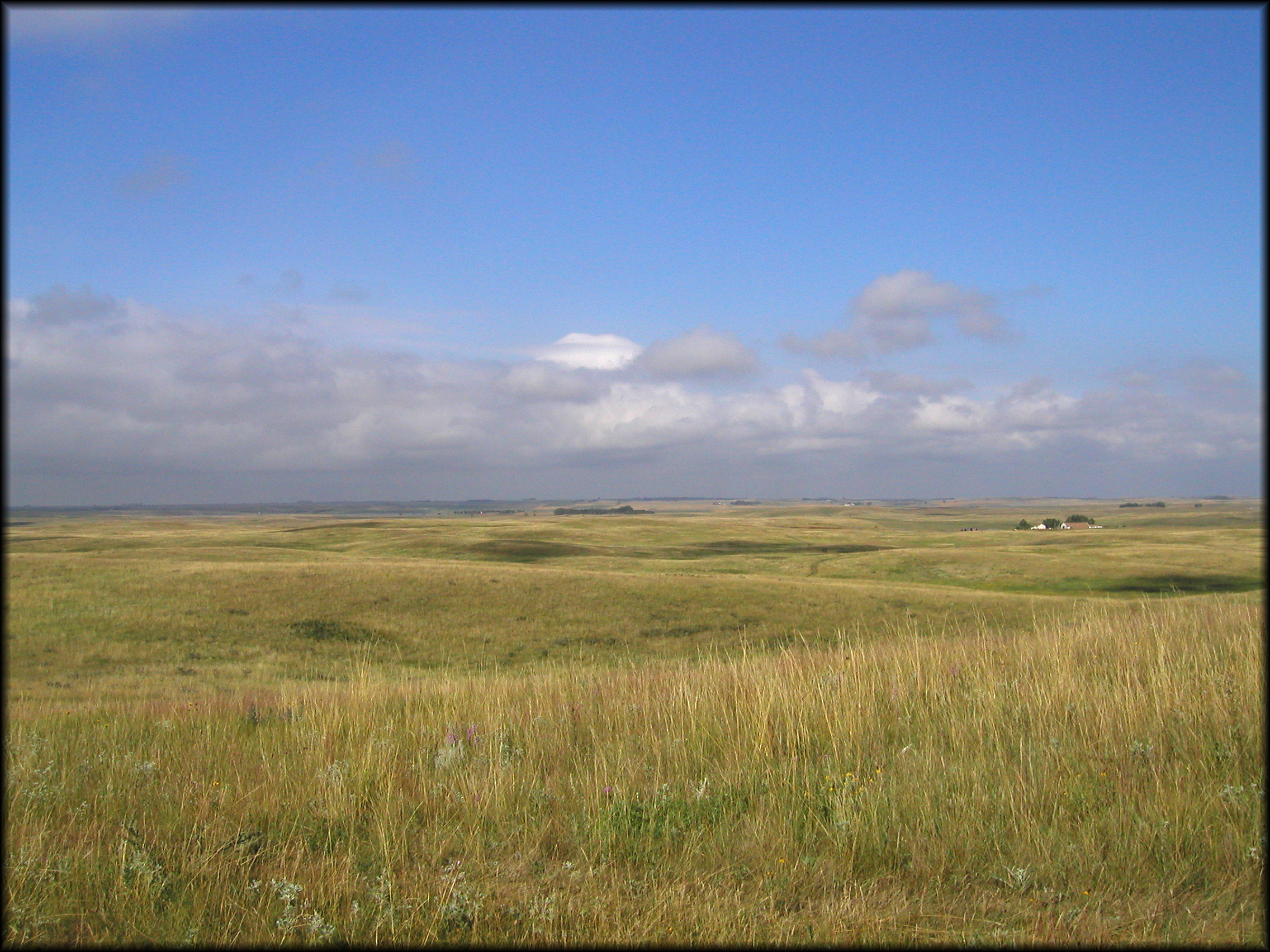
At the end, Swamp Angel takes Thundering Tarnation's pelt out to Montana as a bear rug in front of her cabin. The place where she moved the pelt is known as the Shortgrass Prarie. I haven't learned anything about the Shortgrass Prairie before, so I Googled it and found all sorts of interesting sites, one of which I linked below. I think it is good to include unfamiliar items in a book to spark a students' interest in it and get them to find out more information about it.

Teaching Ideas: This story could be incorporated into a Language Arts and Geography Lesson. Students could create their own tall tale to explain why something is the way it is. (for example - how Grandfather's Mountain came to be; the face in the mountain) They could also look up different types of land throughout the United States, focusing first on the Shortgrass Prairie. Sites like the one I just linked could be used by the students to gather information on the types of animals and plants that are found there.

Sunday, February 24, 2008

Tuesday


Author/Illustrator: Wiesner, David
Publisher and Date: Houghton Mifflin Company 1991
Genre: Wordless Picture Book, Fantasy
Age Level: K-3
Awards: The Caldecott Medal

Summary: Tuesday is a story of a large number of frogs who are set free one Tuesday evening, soaring around town on their lily pads. They leave their home at the swamp, and fly through a nearby neighborhood. The frogs stir up a lot of commotion and leave the town scratching their heads. In the morning they return safely to their home at the swamp. The next Tuesday, some pigs have their chance to fly.

Response: I LOVED this book! I was a little skeptical of wordless picture books, but I gave this one a chance since it had won a Caldecott Medal. I enjoy the fact that the narration, which is left up to the reader, is simply guided by the illustrations. This leaves all the creativity in the story up to the reader. There are so many different things younger children could come up with, from reasons why the frogs are flying where they are to what they are even thinking. I would like to be able to challenge my students to think creatively by 'reading' through this story.

My favorite page in the book is where the man is sitting in his kitchen having a sandwich and a glass of milk. The expression on his face just makes me laugh. What adds to it is one of the frogs flying by his window, which appears to be smiling and waving at him like nothing is out of the ordinary.

On Wiesner's website it shows how he created Tuesday. I wouldn't think that a picture book would being with a story board sketch, but that is exactly what he did with it. It looked like a small comic strip at first and then he put it into its chronological order. After he had the story line he created a rough sketch in pencil of each page. In order to get an idea of the correct lighting, he used clay models and photographs of frogs, homes and other key elements to the drawings. The finished drawing was done on tracing paper, transferred to watercolor paper, then painted with all watercolor.

All of the illustrations in this book were created using watercolor and watercolor alone. Wiesner did not use any ink lines or any other type of opaque paint. I really admire that. I was never an artist, but I had a few art classes in high school and we used watercolor for one of our projects. It is not easy to work with and you can't really hide your mistakes. Once the color is down, it is there. In the project I did it turned out perfectly except for a little smudge in the white space. I had to create a dove holding an olive branch in its mouth to cover it up and had to use an ink pen to do it. I'm sure the more skilled you are the easier it is to execute a painting with only watercolor. Wiesner did a wonderful job with it.

Teaching Ideas: This book would be great to use as a creative writing activity. Students could write down what they think is going on and write down the thoughts of the characters illustrated throughout the book. They could also be encouraged to write or draw out what they think will happen when the pigs fly around the next Tuesday night. Have them show where the pigs go, what they do, and who they might encounter. Another way to get the students more involved is to have them draw out their own story, following the guidelines of a wordless picture book, like Tuesday.

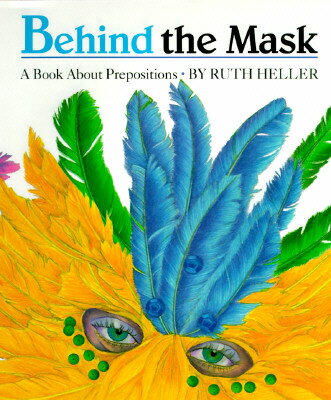
Behind the Mask - A Book About Prepositions


Author/Illustrator: Heller, Ruth
Publisher and Date: Scholastic 1995
Genre: Concept Picture Book, Informational, Poetry
Age Range: 2nd-5th grades

Summary: This is a very informative book on what prepositions are and some proper uses for them. The prepostitions used are made distinct by their bold blue font. The book captures the reader with vibrant illustrations as well as its rhymes.

Response: I really enjoyed reading through this book. The information is presented to the reader in an informal manner, making it fun and easy to learn. I liked how the author incorporated other children's stories into this book. This makes it easier for students to relate and get into the book because it includes something they are already familiar with. One of my favorite pages was the the spread of Jack and Jill. The page reads, "Be angry with a person, but angry at a thing. I'm angry with Jack and I'm angry with Jill... but, I'm angrier still at the pail and the hill." Students learn without even realizing it, because they are seeing some of their favorite storybook characters.

This book not only lists several prepositions throughout the book but adds in rules about the proper usage of them. For example, using two prepositions is not always better than using one. They are also okay to use at the end of a sentence, but it might not always be the best way to word the sentence.


Teaching Ideas: This book, of course, would be perfect to use as part of a Language Arts lesson. It also could be made avaiable to students throughout the day if they finish assignments early. I think students would enjoy this book with its rhymes and pcitures, but also with its educational content.

Baseball Saved Us


Author: Mochizuki, Ken
Illustrator: Lee, Dom
Publisher and Date: Lee & Low books Inc. 1993
Genre: Historical Fiction
Age Range: K-3
Awards: 1993 Parents Choice Award

Summary: This is a story told by a little Japanese American boy whose family was taken away to an internment camp. He doesn't understand why the other kids at school made fun of him or why they have to stay in a dusty camp that isn't fun. The boy's dad comes up with the idea to build a baseball field in the middle of camp and they have a tournament. At the end, the boy is back at school where he was before the camp and they are playing baseball. People still make fun of him but his teammates encourage him and he hits a home run.

Response: I have never learned much about the Japanese Internment camps that were set up in the middle of the American deserts. This book taught me some of what it might have been like for those who were taken away from their homes to live there. The author's note in the beginning was very helpful in providing the background information for the time and setting of the story.

On the second page of the story it tells how the boy was taken out of school one day because him and his parents had to move out of their house really quickly. It tells how a bus took them away to a place where they had to live in horse stalls until they got to the camp. I can understand trying to protect our country from people who could potentially do a lot of harm to it, but that is just ridiculous to me. It is awful to think that we put our own people in situations like that. I can't imagine what I would think or do if my own country turned its back on me.

Teaching Ideas: This story would be good to use when talking about discrimination and even bullying. Students would probably be able to relate it most to the events of 9/11 and how we, as Americans, tend treat people of Middle-Eastern descent now. It is a terrible situation to be in, but we have to move on and not hold people accountable to how others have wronged us just because they look alike. I think it goes back to Because of Winn-Dixie where Gloria Dump tells Opal not to judge other people because of their past but to look at what they're doing now. In this case it isn't necessarily a specific person's past but the events of the past.