Showing posts with label Novel. Show all posts

Friday, April 25, 2008

No Hay Posada


Title: Becoming Naomi León
Author: Ryan, Pam Muñoz
Publisher and Date: Scholastic Inc., 2004
Genre: Novel, Realistic Fiction, Multicultural
Age Range: 4th-6th grades

Summary: Naomi lives with her great-grandmother, Gram, and younger brother Owen in Avacado Acres Trailer Rancho in Lemon Tree, California. She has been raised by Gram ever since her mother Terri Lynn, aka Skyla, dropped them off with her so she could go find herself. Naomi loves making lists, one of the things she was best at according to Gram. A few of her lists were: Things I Am Good At, Regular and Everyday Worries, Unusual Names and Superb Spanish Words. One day Skyla shows up at Lemon Tree with her boyfriend Clive. They want to take Naomi with them to Las Vegas so Clive's daughter Sapphire would have an older sister, a.k.a. babysitter. Skyla doesn't want Owen though because of his physical deformity. To stop Skyla from taking Naomi to Las Vegas, Gram gets temporary guardianship papers and sets off for Oaxaca City, Mexico with their neighbors in Avacado Acres for La Noche de los Rábanos and to try and find Naomi and Owen's father, Santiago. They have a wonderful time participating in the festival, and Naomi get to carve a lion for the carving contest and meet her father. After the festival Naomi, Owen, Gram, and the neighbors go back up to California for the court hearing. There Naomi is brave like her father told her to be and tells the judge about Skyla and how she doesn't want to live with her. In the end, Gram gets custody of the children and Naomi has grown to be strong as a lion with a greater knowledge of her Mexican culture.

Response: I absolutely loved this book! Hispanic cultures are fascinating and they are my favorite to study. I loved the Mexican cultural markers used throughout the book; they gave a great insight to the culture itself and the people that are part of it. I strongly disliked Skyla and Clive, as I would hope anyone would. The only thing I saw them as were irresponsible moochers, trying to make some quick money by trying to take Naomi.

I chose the title 'No Hay Posada' for my blog because of the cultural tradition of las posadas. In the book, Naomi learns about and celebrates part of her Mexican culture by participating in las posadas (in chapter 15). The people of the town celebrate this from December 16 to the 24. On this night described in the book, the town gathers together and goes from house to house asking for a place to sleep just as Mary and Joseph from the Bible did. The person inside their house tells them there is no room, no hay posada, and then comes out to join the rest of the group as they continue on to the next home. When they have gone around to all the houses, the people gathered at the inn where they had begun. I found lyrics to the song they sing as they go door to door. They're in Español as well as English for those of us who aren't fluent. :)


    Listed here are the criteria for good multicultural literature from the Temple text.
  • Do the author and illustrator present authentic perspecitves?
  • Is the culture portrayed multidimensionally?
  • Are the cultural details naturally integrated?
  • Are details accurate and is the interpertation current?
  • Is language used authentically?
  • Is the collection balanced?

I believe that every criteria is met in Becoming Naomi León. I think Ryan presents a most authentic insider perspective of the Mexican culture by having the story written from the point of view of Naomi, who is experiencing some of it for the first time herself. There is not any stereotyping of the culture because Naomi loves and embraces the language and culture of her father and other relatives. The culture is multidimensional in the book by showing a variety of characters from that culture who aren't all the same or do the same things, but who share common traditions and beliefs. The details about Mexican culture that arise in the book do not cut the flow of the story, but go right along with it. Like I mentioned earlier, it is a learning experience for Naomi. This allows the reader to learn right along with Naomi without stopping the story to say, "This is a piñata, etc.". I believe the details to also be accurate to the story, along with correct interpretations of the little Spanish that is used in the book. I like the incorporation of Spanish in this book, and think it is a great way to help other children to pick up on a few words, possibly encouraging them to learn more. The words and phrases used throughout the book were authentic, especially during the time they spent in Oaxaca, Mexico. Although this particular book does not consist of a collection of books about Mexican culture, but it is indeed one I want to have in my classroom.

Some of the cultural markers that I was able to pick up on were: Noche de Rábanos 23/12/07, language, food (mole p.157, pan dulce p.167, buñuelos), huaraches, sense of family, las posadas, piñata. Each of these markers were introduced as the story went along without interrupting the story line.

One of my favorites from this list is, of course, the food. I love to eat especially foods from different cultures. I haven't had mole before, but in a Spanish class I had last summer there was a Mexican girl in there who would always gush about it with our instructor and I've been dying to try some ever since. The link I attached to the mole has many different recipes for it. If anyone has had it before and can give me a good recipe, I'd be much obliged. I am a sucker for sweets, so the next two foods I listed I could eat up in a heartbeat. I linked them to recipes as well.

I was very excited to find a youtube video link to la noche de los rábanos, where the people carve radishes and visit with one another by talking, dancing, etc. I loved the fact that the video is also from this past December! It would be so much fun to visit Oaxaca City during this time and participate in the festivities and see the creative carvings. Another video I found was of the fireworks during the night of the radishes.

Another big part of Mexican culture is family. One's family is usually very tightly knit, and creates a tremendous sense of belonging. I think it also stands true for most Hispanic cultures. Families I have met and had a chance to spend time with in Venezuela have been so welcoming and simply love on you. They are more than willing to offer anything they have to you in order to make you comfortable. Good 'ol southern hospitality cannot even begin to compare.

Teaching Ideas: Using the back of the book for directions/supply needs, students could create their own soap carving to display. After completing their carving, they can write a story about why they created what they did and how they saw it in the soap. Here is a class who has done this activity and posted it online.

As a way for the students to experience the culture, you could use any one of the recipes to share with the class and talk about the significance of the food. A piñata could even be incorporated, but I wouldn't suggest using one made of clay.

Friday, April 18, 2008

Junie B., First Grader: Cheater Pants


Author: Park, Barbara
Illustrator: Brunkus, Denise
Publisher and Date: Random House, 2003
Genre: Realistic Fiction, Novel
Age Range: 1st-3rd grades

Summary: In this book, Junie B. learns that cheating isn't just when you copy someone's answers on a test. Junie B. forgets her homework one day and copies May's 'A+ homework' so she won't get in trouble. She thinks she lucked out when Mr. Scary asks them to stand up and read what they wrote for homework. Only, Junie B. doesn't read from her paper when it is her turn. She gets caught and Mr. Scary sends a note home to her parents explaining what she did. The next day in class, the desks are arranged in groups and Mr. Scary has them write a cinquain. After writing their poem, the class was given a spelling test and Junie B. copied 'would' off of Herb's paper. They both felt bad about it and confessed what they'd done to Mr. Scary the next day.

Response: I really enjoyed this book and think it would be a great series to keep in my classroom. The thing that stuck out to me the most was the language used by Junie B. and her classmates. It wasn't perfect English all the time, but it reminded me so much of how first graders communicate with each other.

My senior year in high school I had an internship with a first grade class at my old elementary school. That class was great to work with and I really enjoyed spending time with them during the lessons. This book in a way reminded me of that class and how much I really want to start teaching is first grade after I graduate from Appalachian.

The illustrations were very fitting to the characters themselves. The first illustration shows Junie B. and May sitting at their desks in the classroom. By May's expression the reader can see, before the book even begins, that May thinks she is a great student and better than her peers in Room One.

I also liked how there were students like José in the classroom that could incorporate language from their culture into the cinquain poem they were writing. In any classroom today you will surely find students from various cultures. Students will have to learn how to interact with them if they don't know already, and treat these students just like anyone else like José's friends treat him in this book. Having a variety of cultures in the classroom would open up doors to learning about the student's cultures and maybe even having them teach the class a little about it.

Teaching Ideas: This book contains a good message about cheating, no matter what day the students may read it throughout the year. It shows them that it is wrong and how you can get in trouble for it. The students could learn from Junie B. and Herb's mistake and see that they did the right thing by telling the teacher what they did. Being honest in your schoolwork is always the best and is a true reflection of what you have learned.

For a language arts lesson, students could be given the rules of a cinquain again and be asked to write their own cinquain about whatever they would like.

Cinquain Links:

Thursday, April 17, 2008

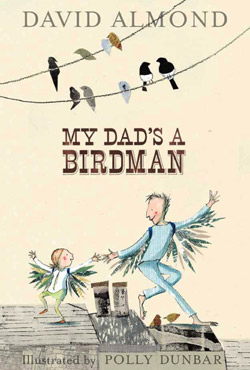
My Dad's a Birdman


Author: Almond, David
Illustrator: Dunbar, Polly
Publisher and Date: Candlewick Press, 2007
Genre: Illustrated Novel
Age Range: 3rd-5th

Summary: This lighthearted story is about a Father named Jackie and his daughter, Lizzie who live together. Lizzie's mam is no longer living. One day Jackie joins the Great Human Bird Competition that Mr. Poop is announcing and makes his own bird wings in order to participate. He even goes so far as to eat bugs! Lizzie stays home from school and ends up signing up for the competition as well. Auntie Doreen visits and thinks all of it is crazy and even brings Mr. Mint by to try and straighten the two of them out. Mr. Mint joins the competition as well, despite the flying dumplings thanks to Auntie Doreen. At the competition everyone who participates falls right into the water instead of flying but they all have a wonderful time and dance together at the end.

Response: My favorite part of the book were the illustrations. They were done in pencil, watercolor and collage. One of my favorites is a two page spread on pages 82 and 83 where Jackie and Lizzie were dancing in their living room with the bird wings on as the moonlight shone into the room. Their outline is in pencil and they are colored in with watercolor. The wings are the collage and I absolutely love them and love how the whole picture comes together. Another one of my favorites is the two page spread on pages 58 and 59 where Jackie and Lizzie have made a 'nest' and are sitting in it holding an imaginary egg between the two of them. Again i like their wings, but also in the nest is a piece of newspaper! The nest is a whole assorment of items and little paper clippings, but I really like the piece of small newspaper that is included.

As far as the actual story line, I did not enjoy it as much as I thought I would. I might be able to appreciate it more if I read some more of Almond's work, but I just was not impressed. I did not like at the beginning where it seemed like Lizzie was taking care of her (what seemed to be) deranged father while he ate bugs and worms, refusing real food.

I think this is a great novel to get children reading as a transition to larger chapter books and novels. I really liked how the chapter 'titles' were the first few words of the beginning sentences of each chapter. This lets you get right into the reading and allows it to flow better instead of having each chapter be its own separate story.

Teaching Ideas: This book could be incorporated into a science lesson on birds and what allows them to fly. Students could also discuss why people can't fly (except for on an airplane or helicopter!). In learning about birds, the purpose of a nest could be discussed and students could take a short trip outside to gather materials they think would make a good nest. When back inside, students could create their own birds nest and make an egg out of play-doh or clay to put inside it.
For language arts and art, students could draw a picture of an outfit they would create to make them fly. After drawing the picture, they could write a story about how they made it and what it would do to help them fly.

Tuesday, April 15, 2008

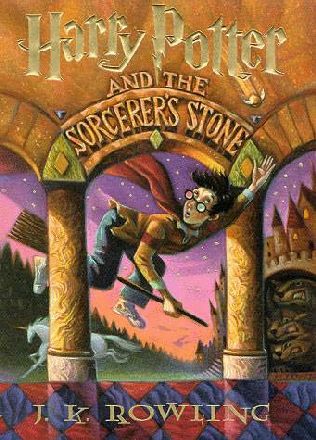
Harry Potter and the Sorcerer's Stone


Author: Rowling, J.K.
Illustrator: Grandpré, Mary
Publisher and Date: Scholastic, Inc., 1997
Genre: Fantasy, Novel
Age Range: 4th-6th

Summary: Harry Potter is a young boy who lives with his Aunt, Uncle, and cousin Dudley Dursley on Privet Lane. His parents were killed by the infamous you-know-who (Voldemort) when Harry was just a baby, and the Dursley's were the only family he had left so he was left to live with them in the muggle (human) world. Harry is overshadowed by his cousin Dudley all through their youth, up until Harry's 11th birthday when he receives numerous letters from Hogwarts, despite his Uncle's attempts to destroy them, inviting him to come to school for the next term. Hagrid comes to rescue harry from the hut on the rock at midnight on his 11th birthday and they stop by Gringots to get Harry's money (and something from a secret safe for Hagrid) before they go shopping for Harry's school supplies in Diagon Alley.

On the way to Hogwarts, Harry meets Ron Weasley and Hermione Granger who become two of his best friends at Hogwarts, and they are all sorted into the House of Gryffindor. Draco Malfoy, on the other hand, is someone Harry learns to hate rather quickly. Draco thinks he is better than Harry, or anyone at all for that matter, and constantly teases and taunts Potter and his friends. Harry and his friends befriend Hagrid and have many adventures while they are at Hogwarts, despite Malfoy's attempts to ruin it for them. While getting caught flying on his broom when he wasn't supposed to, Harry lands a spot on Gryffindor's Quidditch team as the new Seeker and the youngest player in centuries. When challenged by Malfoy to a wizard's duel, Harry, Ron, and Hermione find Fluffy in the forbidden corridor on the third floor. On Halloween when a troll was wandering the halls of Hogwarts, Harry and Ron go to warn Hermione who has been in the girls' room crying, and end up saving her life. One night, while using his invisibility cloak, Harry finds the Mirror of Erised which shows him his family. Harry and his friends find out about the sorcerer's stone and that Nicolas Flamel is the only one who has one, which is guarded at Hogwart's by Fluffy and other spells from Professors at the school. Hagrid brings a dragon egg home from a bar one night which Harry and Hermione sneak up on top of Hogwarts for Ron's brother's friends to take with them since dragons are illegal at Hogwarts. Harry, Hermione, Neville, and Malfoy get detention for being out the night they got rid of the dragon and have to go into the forbidden forest to find a unicorn that has been hurt. There the group meets who they later find out to be Professor Quirrell, drinking the unicorn's blood in order to keep his other 'face' alive for just a while longer. At the end, Harry, Ron, and Hermione save the school from Professor Quirrell, and ultimately from Voldemort taking over. From the spells they learn, they are able to work together to get past Fluffy, Devil's Snare, the flying Keys, a life-size game of chess, a knocked-out troll, a line of bottles, and to the sorcerer's stone itself which the Mirror of Erised showed to Harry. Dumbledor comes to Harry's rescue in time, not allowing Voldemort to do enough damage to Harry to kill him, and Harry becomes the hero of the school and even more famous. The book ends with all of the students going back home, some to the muggle world, for the summer where Harry is looking forward to the fact that Dudley doesn't know he isn't supposed to use his magic away from Hogwarts.

Response: I had always heard how much better the books were than the movies and wasn't sure if I'd really ever think the same. After reading the first book I want to read entire series, which I'll probably get started on this summer. The description in the book is incredible and I loved every minute of it!

I think the power of love is such a strong theme in Harry Potter. The reader knows all throughout the book that Harry's parents had cared for him and did love him because they didn't just send him to live with the Dursleys, they were killed by Voldemort and that was the last option for the time being. His parents were well off and had money for Harry when he did get to Hogwarts, so their love for him is shown in this way as well. However, it isn't until the end of the book when you see the true power of the love Harry's mother had for him. When Voldemort knew Harry had the stone and tried to escape with it, he screamed at Quirrell to 'SEIZE HIM' and 'KILL HIM' but the moment Quirrell touched Harry's skin, his began to blister in pain. Dumbledore explains why this happened on page 299. He says to Harry, "Your mother died to save you. If there is one thing Voldemort cannot understand, it is love. He didnt' realize that love as powerful as your mother's for you leaves its own mark. Not a scar, no visible sign...to have been loved so deeply, even though the person who loved us is gone, will give us some protection forever. It is in your very skin. Quirrell, full of hatred, greed, and ambition, sharing his soul with Voldemort, could not touch you for this reason. It was agony to tocuh a person makred by something so good."

There are all sorts of rule-breaking and rebellious characters in this book. The first that come to mind are the Weasley twins, two of Ron's older brothers. They loved to find secret passageways at Hogwarts and joked with their mother about sending her a toilet seat from school (which they actually did send to Harry at the end). Harry had numerous times when he was breaking the rules. He flew on the broom his first time without Professor McGonagall there, was a first year who played on the Quidditch team, had his own broom, snuck out many times with the use of his invisibility cloak, went to save Hermione with Ron while the troll was loose, and even went to the forbidden chamber on the third floor in order to save the school from who he thought to be Voldemort. Hagrid and got his own dragon, fully aware of the fact that they were illegal and used his magic when he came to get Harry in the muggle world.

Teaching Ideas: This book could be used in a language arts lesson in a couple of ways. Since the characters use different spells to open doors, make things float, change something into something else, etc. students could create their own spell. Have them write down what hte spell is and write a story about what situation they would use it and what it would do. They could also draw a picture to go along with it.
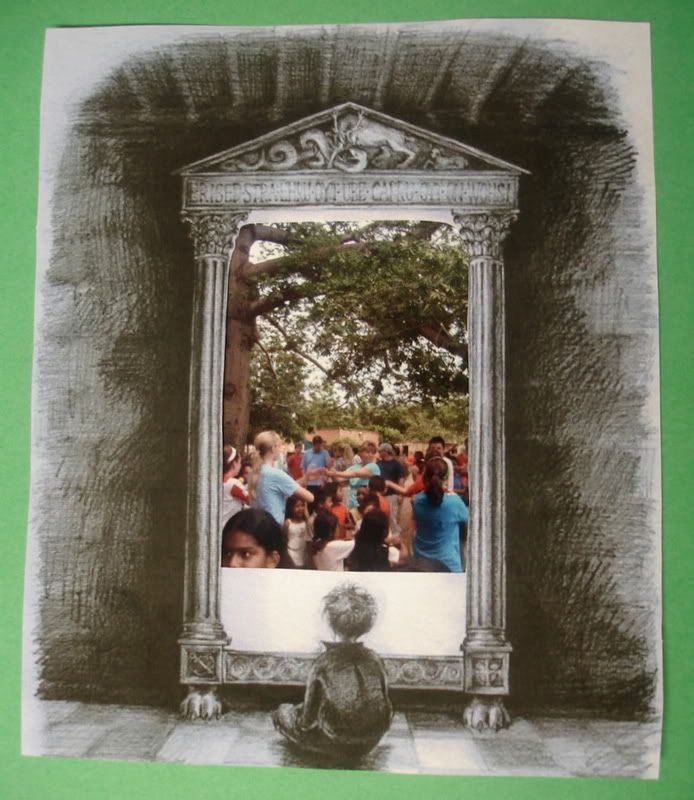
In using the Mirror of Erised, Harry saw his family because that was the deepest desire of his heart. Give students a "mirror" printout and have them draw what they would see in their Mirror of Erised. In addititon to the picture, students will also write a short story explaining why they would see what they drew.

For a science lesson, students could learn about owls and dissect owl pellets. If actual owl pellets are not available for the students to use, take them to www.kidwings.com where they can virtually dissect an owl pellet. This might be a little easier on some students anyway! On the site it has different bone parts labeled and will say the name of them when you click on it. As you pick bones out and drag them up to the matching picture, it builds the animal the owl has eaten.


Mirror of Erised


The Mirror of Erised in Harry Potter shows the one who looks in ‘the deepest, most desperate desire of their heart. Harry was able to see his family, whom he had never met and at the end it showed him finding the Sorcerer’s Stone. If I were to look into the Mirror of Erised, I would see myself in Venezuela, like in the picture below. The deepest, most desperate desire of my heart is to serve the Lord in missions. I love the children and being able to play with them and talk with them the most. I can’t wait to travel all over to do this, but especially to more remote and poor areas like the communities I have been to in Maracaibo, Venezuela.

Saturday, March 15, 2008

Small Steps


Author: Sachar, Louis
Publisher and Date: Delacorte Press, 2006
Genre: Novel
Age Range: 4th-6th grades

Summary: Two years after leaving Camp Green Lake, Armpit is back home in Austin, Texas. He and his disabled neighbor, Ginny, are good friends and an encouragement to each other. Armpit is trying to turn his life around and is doing a good job as he digs for Raincreek Irrigation and Landscaping under a man named Jack Dunlevy. X-ray, his friend from Camp Green Lake, gets him back into a mess of trouble when he thinks they can make some fast money by buying and re-selling Kaira DeLeon concert tickets. Armpit and Ginny go to Kaira's concert with counterfeit tickets and Ginny has a seizure when they get caught. The two end up meeting Kaira and watching the show from backstage. Kaira takes a liking to Armpit and has him flown out to another concert where he is framed by her agents and almost killed by her step-father and manager, El Genius. Kaira survives the attack, the evidence to frame Armpit is used against Kaira's step father, and Kaira continues to write her music.

Response: I loved this book! It's setting was completely different from Holes, but I like how a couple of the characters carried over into this new adventure. I like how Armpit is straightening his life out, but still manages to step into some trouble with his mischievous friend X-ray.
Armpit's relationships with two people really stuck out to me. The first was with him and his 10-year-old disabled neighbor. Armpit was able to be himself around Ginny, and they really encouraged one another. Ginny did not judge him because of his record and staying at Camp Green Lake and Armpit did not judge her because of her disability and stutter.
The other relationship I liked was that between Armpit and Kaira. It reminds me of relationships my friends and I had with boys in elementary school. It was awkward and you acted goofy but it made you all excited at the same time. Their relationship with one another was innocent and adventurous. It was innocent in that they were both young and didn't know what relationships were about. They were just having fun. The adventurous part comes in where Kaira is a superstar and Armpit is a kid with a record. They ran off together at the country club and she flew him out to meet her for another one of her concerts. Their relationship spurred those working for Kaira to frame Armpit when he really didn't do anything that time.

Teaching Ideas: This book teaches that you should not judge others because of their past or how they appear. People with disabilities still have feelings and can communicate, they may just do it differently. It takes me back to Because of Winn-Dixie where Gloria Dump tells Opal not to judge other people because of their past but to look at what they're doing now.
I think it also teaches a good lesson on gambling and counterfeiting. It is not wise to invest in something just for some quick money. I think that is a growing problem in today's society and children should learn from the mistakes of others early on so they will not have to repeat them.

Monday, February 11, 2008

The Thief Lord


From the Book
“The alleys they walked through became narrower. It was quiet between the houses and soon they entered the hidden heart of the city, where there were hardly any strangers. Cats darted away as their footsteps rang out on the paving stones. Pigeons cooed from the roofs. The ever-present water swayed beneath the bridges, splashing against the boats and wooden posts, and reflecting back the old faces of the houses. The children wandered deeper and deeper into the maze of alleys. The houses seemed to be moving in on them, watching them, as if they knew who they were.”
p.22 par.2

What this means to me
The imagery used makes me feel like I am right there with the children, sneaking off to their secret hiding place through the alleys. I can just picture the cats being startled by the echoing footsteps of the children as they creep along the alleys between the tall houses.

The metaphor the author used to say the children’s home was “the hidden heart of the city” was really clever. I took it to a more literal standpoint as in a heart of a person, their inmost being. The Star-Palace is where the children had made their home, as much as a theatre can be a home for street children. Their hearts lay there with their most prized possessions and it was where they spent time growing together.

I really like how the author personifies the houses at the end of the paragraph. It gives you the sense that this is where the children’s safe haven in Venice was, like the houses were protecting them and shielding them from the rest of the city.


Overall, I really enjoyed reading The Thief Lord. Funke did such a wonderful job with developing the characters throughout the story as well as the imagery. Once I got into the reading it never left me bored and was full of surprises.

My favorite character in the book was probably Ida. I loved how she was still such a child at heart and truly cared for the children (even after they broke into her house to steal the wooden wing). Her and Hornet had a strong connection after the police caught Hornet and took her to the orphanage where Ida once lived. Ida was so compassionate toward the children, but especially toward Hornet. I think she was truly able to understand what Hornet was going through in the orphanage because of her experience. I really enjoyed the fact that Ida and Victor (in disguise) went over to the orphanage together to claim Hornet as their own so she could be reunited with the rest of the children. Ida was really a character to look up to and someone the children really admired.

Carnival at Candlelight


At first I was not sure whether or not I would enjoy reading Carnival at Candlelight. I was convinced that it would just be some corny story of a make believe adventure of two children. I am happy to say that I was proved wrong and I can understand why it is so popular among children today.

I specifically like the fact that it encourages children to use their imaginations even when they might think it won't work. There was a theme of being patient that I also noticed throughout the book. With the way our society is now, everything is so fast paced and hectic. We live in a 'fast food' society where our wonderful technology advancements, as helpful as they may be, have us trained to expect gratification in an minutes time... or less! The children in the book got ahead of themselves a couple of times, but then had to re-trace their steps. Patience is a big thing and children would benefit greatly from learning this practice early on.

When I was trying to figure out how to incorporate this Magic Tree House series into the classroom, I visited the Magic Tree House Web site. There is a link for the Merlin Missions books within the series and on that page is a link to print out your own passport. I am a big traveler myself, so when I found this it really caught my attention. Children can print out their own 'Official Magic Tree House Passport' and collect stamps to put in it after they complete a book in the series. If you click on any of the books listed on the site it will take you to a page that tells a little about the book itself with a short quiz underneath. After answering the questions on the quiz correctly it will give you a link to a stamp you can print out for your passport. This would be a great way to motivate the children to read more of the books.

Throughout the book it gave little definitions and facts about people and places in the story. It helped the two children in getting through their adventure and also allowed the reader to have more insight as to where they were and what it might be like. I enjoyed reading through them and learning a little bit about Venice myself. Overall this book was very enjoyable and I hope to read more of them in the future!

Because of Winn-Dixie


This is the type of book that warms your heart, and makes you smile so hard that you sneeze! (Sorry, I had to. That was one of my favorite parts!)

I really enjoyed this novel by Kate DiCamillo. I fell in love with Winn-Dixie from the very beginning and I could tell Opal was a special kind of girl as well. The two had such a strong bond and Winn-Dixie was just what Opal needed to get her started in a new town.

In Chapter 8 of our Temple text, it discusses Realistic Fiction and provides many different categories and books that would fit into them. Because of Winn-Dixie is in the 'Books about Nature & Animals' and rightly so. I feel like it could also fit into the category of 'Books about Self-Discovery and Growing Up'. I say that because Opal developed so much through the relationships she built with the characters in the book, even with the Dewberry boys.
Opal Learned from Gloria Dump to not judge other people because of their past but to look at what they're doing now. That helped her to look at the everyone in a new light and give people a chance. Opal learns why Amanda is so 'pinch-faced' and Gloria tells her that sometimes 'the whole world has an aching heart'. I think that teaches Opal some empathy and allows her to relate better to people because of the aching heart she has from her mama leaving.

I think DiCamillo creates a very authentic setting with this book. It is in a small town with everyday people in a somewhat middle class area. None of the characters are perfect, and neither are the families. It shows that everyone comes from a different background, learns from what has happened, and helps other people to also understand what they have learned.

One of my favorite characters in this book was Otis, and it may just be because I have seen the movie and Dave Matthews plays this character. He is a very free-spirited person who just wants to play his music. The book made you feel sorry for him for having been put in jail. All he was doing was playing his music, not even asking money for it and the police had to go and cause a scene with it. Granted, I know I am guilty of rolling my eyes at people in big cities who stand at a corner and play their music with their instrument case sitting in front of them for anyone who wants to leave some spare change. It was intriguing how Otis was able to calm the animals with his music in the pet shop. I know music calms me down when I am stressed, so I can relate to the animals in that sense. It must really stress animals out when they are caged up all the time.

I really liked the idea of the Littmus Lozenges Miss Franny told Opal about. I know such thing doesn't actually exist, but I found a web page online a class made that has their own recipe for Littmus Lozenges, minus the ingredient of sorrow. The whole concept of the candy made me think that there are bittersweet moments throughout life. It is good to recognize them every once in a while to remember where you have come from, and how far you have come along since then.

Saturday, February 2, 2008

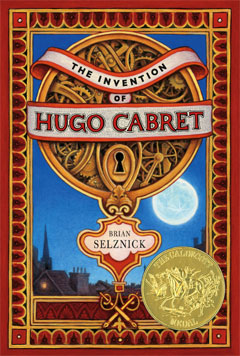
The Invention of Hugo Cabret


Author/Illustrator: Selznick, Brian
Publisher and Date: Scholastic Press 2007
Genre: Illustrated Novel, Historical Fiction
Age Range: 4-6 grades
Awards: Caldecott Award Winner 2008

Summary: This book is about an imaginative young orphan boy named Hugo Cabret who lives behind the walls of a train station in Paris. He steals from local shops to survive keeps the clocks running to cover the disappearance of his uncle. Hugo's stealing brings him in the path of a famous magician and filmmaker, Georges Méliès who has tried to shut his past out of his life. Hugo is able to help bring Méliès' past back to life and Méliès gives Hugo a home and a family.

Response: I absolutely loved this book! Selznick's illustrations are so detailed and captivating, it made the book seem like a movie with subtitles. I like how it tells the reader to picture yourself in a theatre before the movie starts. It brought that type of anticipation and had me trying to guess what would happen next.
The description in the book was very well done! I loved the pages that described the automaton. It made me feel like I was right there watching it draw out the picture of the man on the moon with the rocket in it's eye.
I enjoyed the incorporation of actors, movies, and machines of the time. It made the story more realistic and had you learning some history without digging into a history book.

I liked the extra information Selznick included at the back of the book. A link he provided shows a video of an automaton in action. I also looked up some of Méliès' movies on the internet and found a video of A Trip to the Moon on youtube. It is in French, but it is still really neat to see the actual film.

Teaching Ideas:
This book could be used as a lesson on the time period and the people that lived in it. Also could be used in an art or film lesson and look at works from that time period and how they differ from more contemporary works. For a more hands-on activity the children could draw or make out of clay their own automaton and write a story about what they would have it to write or draw. They could also reenact the movies mentioned in the book from their perspective. These could all be performed in front of the class as their own 'Georges Méliès' rememberence day.