Showing posts with label Picture Book. Show all posts

Monday, April 21, 2008

First Day in Grapes


Author: Pérez, L. King
Illustrator: Casilla, Robert
Publisher and Date: Lee & Low Books, Inc., 2002
Genre: Multicultural
Age Range: 1st-3rd grades

Summary: This is about a boy named Chico, and his family who are migrant workers and move from one migrant camp to the next. Chico doesn't like going to school because the kids pick on him there and call him names; he wants to be a race car driver. When he gets to school he makes friends with John Evans and likes his new third grade teacher, Ms. Andrews, who can hit a home run. Ms. Andrews is an encouragement to Chico and makes him feel good about his school work, especially in math. At lunch the mean 4th grade boys make fun of the tortilla his mother made for him. Chico stood up to the boys because his mamá wanted him to be strong and have courage. Chico used his math skills to ask the boys addition problems that they weren't able to answer. He stood up for himself without fighting to the kids everyone else was scared of.

Response: The reason I chose to read this book was because of the biographical book I read earlier on Hugo Chavez and how he fought for the rights of migrant workers. This book was not as much about migrant workers as it was about a boy's first day at a new school, which every child can relate to! Like a lot of children, Chico was nervous about going to school because the other children there always seemed to pick on him. Unfortunately there are always students that are picked on by the 'cool kids' in class, and there is not always something done about it. I think this would open up the eyes of many students to see that each person has something they are good at, no matter where they came from, the language they speak, or the color of their skin.

I also liked how the illustrations portrayed the emotions of the characters in the book. I feel like I was able to understand how Chico felt from him being upset about going to school to making new friends and even standing up for himself. The colors used were vibrant and reminded me of a Mexican culture where they love to use lots of color! The illustrations were were done in watercolor, colored pencil, and pastel.

Teaching Ideas: This would be a good book to use on bullying. It can set an example for children on how you can stand up to and approach your bully without fighting or calling them names. It also emphasizes how each student is unique and that they deserve the same respect as anyone else.

Another element of the book that could be used to incorporate more of the culture aspect would be to make tortillas as a class or even bring some in and be able to hand out a recipe for them. This could be used as the snack for the day (and they are delicious if you roll them up with peanut butter!). I doubt the peanut butter is a Mexican tradition, so maybe cheese might be more appropriate to use. Be sure to definitely check for peanut allergies before doing it.

Chicken Sunday


Author and Illustrator: Polacco, Patricia
Publisher and Date:
Genre: Multicultural, Picture Book
Age Range: 1st-3rd Grades

From the Author Study Literary Critique on Chicken Sunday:

Chicken Sunday is a true story about Polacco’s childhood. It is about her relationship with her neighbors, Stewart and Winston, and their gramma, Eula Mae Walker. On some Sundays, little Polacco would go to the Baptist church with the three of them and have lunch afterward. The children decide to get a hat for Miss Eula but don’t have enough money so they go to Mr. Kodinski’s shop to ask if they could work to pay off the difference. They make Mr. Kodinski Pysanky eggs to show him they didn’t throw eggs at him and learn about his life (he is Jewish). They get the hat for Miss Eula and she loves it.

The genre of Chicken Sunday would be a multicultural and nonfiction picture book. It gives Multicultural literature are works reflecting the multitude of cultural groups within the United States (Temple Text). The reader is given an example of another culture within the society, showing that there is more than one way that people live. This gives some insight to various traditions or customs that they would not necessarily encounter on a daily basis. The story is also one that is true and has actually happened in the past. The characters in it are not just created within the author’s mind, but rather are actual people. This gives the book a strong validity and gives the story more authenticity.

While going through the qualities of outstanding children’s literature in our Temple text, I could not find one that Chicken Sunday, or any other of Polacco’s works that I have read, did not fit. This book most definitely expands awareness. Temple says, “They broaden children’s understanding of the world and their capacity for empathy”. If her literature does not do that, I do not know what does. Because she writes from her personal experiences, she allows the reader to share that with her and to become empathetic towards the ones she writes about. As I stated earlier, Polacco’s works contain lessons within them without being too obvious or pushy with them. The truth in her books gives them their quality, integrity, and originality. The characters are true to life and certainly believable because, in most of her work, they are people with whom she has had real life experiences. I have not come across one of her stories that makes me think that I had heard it somewhere before. Polacco is creative in how she presents the stories in her books, each one of them containing a different setting and subject.

The characters in Chicken Sunday appealed to me the most and seemed to be the book’s strongest point. I think everyone has a Miss Eula in their life that they can relate to. A kind-hearted gramma with a singing voice that was slow like thunder and sweet like rain. I know many women in my home church who love to spoil the students in the college and youth groups, and boy can they sing. Another character I was intrigued by and wished there would have been more focus on was Mr. Kodinski. It never came right out and said Mr. Kodinski was Jewish, but there were hints when Miss Eula said how hard of a life he’d had, the eggs, and especially the number tattoo on his forearm. Ever since elementary school I have been fascinated by the Holocaust. I remember a couple times when a survivor of the Holocaust would come in to give a speech about what they had been through. I also remember seeing a number tattooed on their arm similar to the one Mr. Kodinski had on his. It always amazed me how other human beings could be treated so poorly because of their beliefs and physical appearance. It upset me that Mr. Kodinski was being discriminated against even still when the bigger boys threw eggs at the backdoor to his hat shop. I did like, however, how the three children befriended him and helped him to feel more accepted. I also found it very interesting that Polacco’s second husband was in fact a survivor of the Holocaust.

There are endless classroom connections with Chicken Sunday. The biggest one would definitely be on teaching an awareness of other cultures. If there were students in the classroom that were Jewish, they could share some of their customs and beliefs if they are willing to. By having other students in the class with similar backgrounds to the characters in the book, it would allow them to make stronger connections to the book and also allow the other students in the class to relate to the book more. African Americans are another minority in the book, which was the ethnic background of three of the main characters in Chicken Sunday. From the Sunday meal at the beginning with fried chicken and collard greens to the end with the illustration of the choir, it is easy to see that there is a completely different culture within the United States. Students need to be able to recognize the diversity and know that other people are not any less of a person because of the way they live.

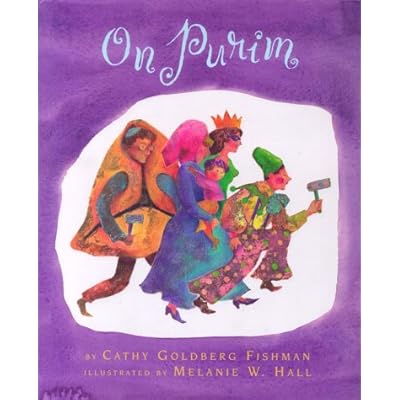
On Purim


Author: Fishman, Cathy Goldberg
Illustrator: Hall, Melanie H.
Publisher and Date: Atheneum Books for Young Readers, 2000
Genre: Multicultural, Picture Book
Age Range: 1st-4th grades

Summary: This book tells about a family as they celebrate the traditions of Purim by dressing up in costumes and wearing masks. They also read about Esther in the Bible and how she saved the Jewish people. In the book they tell the story of how Esther saved the lives of many Jewish people when she married King Ahasuerus and convinced him not to have the Jews killed like the king's chief advisor, Haman, wanted. After the story the grandmother makes hamantashen, a pastry shaped like the hat Haman wore. They then make shalach manot, gift baskets, for each other with hamantashen, candy, and fruit inside. The family also goes to a carnival and parade for Purim to celebrate. On the evening before the 14th of Adar, they dress in their costumes and go to synagogue. In the synagogue, the family gives tzedakah, or charity, and listen as the Rabbi chants from the Megillah.

Response: I really enjoyed this book because I was able to learn something myself from this! I have never heard of the Jewish holiday of Purim, and thought it was really interesting. Every part of what they do to celebrate this holiday has its own significance to the original story of Esther saving her people from the hand of Haman (boo! boo!). See, in the story they make noise with their groggers and say "boo! boo!" at the mention of Haman's name, who tried to get rid of the Jews in Persia. The grogger reminds me of a noisemaker you see people playing with on New Years.

The illustrations are done in collagraph and mixed media. I love the use of color in the illustrations for this book. It portrays the holiday as the happy and victorious time that it truly is for the Jewish people. The only 'dark' illustration is on the page about Haman. Here deeper purples and more black is included to portray this man's disdain toward the Jews.

Teaching Ideas: Even though not all students in each classroom will be Jewish or would celebrate Purim, this is a good book to bring it to show the different traditions of other cultures and religions. I think it would be better to use in addition to a study of holidays in other cultures or religions to show the students how different some people live.

Also, if the children (a.k.a. parents) are alright with experiencing part of this culture, you could make Hamantashen as a class with the recipe I found below!

Saturday, April 5, 2008

Rosa


Author: Giovanni, Nikki
Illustrator: Collier, Bryan
Publisher and Date: Henry Holt & Company, Inc., 2006
Genre: Biography, Picture Book
Age-Range: 4th-6th
Awards: Caldecott Honor, Coretta Scott King Honor

Summary: This is a story about Rosa Parks, the African-American woman who refused to give up her seat in the neutral section on a public bus. Even after the police were called she still refused to get up from her seat, tired of always putting the white people first. The 25 women of Alabama State College’s Women’s Political Council met that night to make signs in support of Mrs. Parks. The Women’s Political Council gathered together with the NAACP and all the churches, to hear Martin Luther King, Jr. speak on their behalf. Dr. King encouraged them to walk instead of taking the buses until ‘justice runs down like water’. Almost a year after Mrs. Park’s arrest, the U.S. Supreme Court ruled that segregation on buses was illegal.

Response: I really enjoyed this book about Rosa Parks. I have heard her story many times, but I liked how it included other information about her life outside of the bus boycott. It talks about her occupation and family life some, which allows people to relate to her more in that aspect.
The illustrations in the book were beautifully done. In the illustrator’s note, Collier talks about the reason why he chose certain colors for the book. The yellow and dark hues were used because of the heat Collier had experienced when he went to Montgomery to research the story. He paints Mrs. Parks as if she is ‘a radiant chandelier’, emphasizing the fact that she was the light that lit the path to equal rights, so to speak. I also like the use of collage in the illustrations in addition to the watercolor; it reminds me of Jenkins’ paper collages.

Teaching Ideas: This fits in well in studies of our nation’s history and changes that have occurred over the years. Diversity in our country and civil rights are also topics related to the book that could be used as class discussion. The topic of bullying could also be tied in to the story, showing students how they can stand up for themselves without being violent in their actions.

Harvesting Hope: The Story of Cesar Chavez


Author: Krull, Kathleen
Illustrator: Morales, Yuyi
Publisher and Date: Harcourt Books, 2003
Genre: Biography, Picture Book
Age Range: 3rd-6th
Awards: ALA Pura Belpré Honor Book

Summary: This biography is of Cesar Chavez. He came from a ranch in Arizona and loved to spend time with his family. When a drought came in 1937 his family was forced to give up their ranch and move to California to look for work. Chavez and his family worked someone else's farm in hopes of saving up money to buy their ranch back, but that dream quickly faded. After 8th grade, Chavez dropped out of school to work in the fields full-time in order to put food on the table. Migrant workers were mistreated by the landowners, sometimes being murdered for complaining of the poor conditions. In his early twenties, Chavez dedicated his life to fighting for a change in the conditions of migrant workers. He taught that truth was a better weapon than violence, something he had learned from his mother when he was young. He organized a march from Delano, CA to Sacramento, CA to ask for help for La Causa (The Cause) from the government. When the march reached Sacramento, it was 10,000 people strong. Chavez won the fight and signed the first contract for farm workers in American history.

Response: The illustrations in this book are vibrant and absolutely beautiful. On the first page spread, the people looked as though there was glow from a campfire in front of them, even though there was no actual fire depicted in the illustration. I think the illustrations match Chavez and his culture almost exactly. His family was from Mexico, and in Hispanic cultures they use lots of vibrant colors in art and even to paint their houses with. I really enjoyed this aspect of the illustrations.

There wasn't one specific emotion I felt throughout the book while reading it. It was more like i felt the emotions of the people in the book as the story progressed. Their faces show how the emotions they are feeling, especially their eyes. I did feel angry, however when Chavez was in school and the teacher hung a sign around his neck saying, "I am a clown. I speak Spanish." because he broke the rule one time about speaking English at all times. I don't like it at all when students are singled out by their teachers. It is not appropriate, especially when you hang a sign around the poor child's neck. There are so many other ways the situation could have been handled that would have gotten the teacher's point across without embarrassing him. I have been singled out before by teachers and it really doesn't benefit anyone. It just leaves the student feeling dumb or embarrassed, which is unnecessary especially if you want the student to be successful.

One quote from the book that stood out to me was the rallying cry of the marchers, "Sí Se Puede", which means, "Yes, It Can Be Done". It is very encouraging and gave the United Farm Workers hope and confidence in their cause and in themselves. The marchers' cry can be inspiration for so many others as well. It encourages one to keep pressing on until they reach their goal. It leaves no room for giving up, only a path to move forward.

Teaching Ideas: In a study of heroes in American history, students could study people (like Cesar Chavez) who made an incredible difference in the lives of many people. Each student could choose a person they don't know much about and read their biography. Organize a "Live Museum" for the students to participate in. They will dress up and act like the hero they have chosen and present the museum to parents, other teachers, etc.


Websites on Cesar Chavez:


Cesar.
Patient, compassionate, courageous, stubborn.
Friend of migrant farm workers.
Lover of truth, justice, and peace.
Who feels uncertainty, perseverance, and accomplishment.
Who finds happiness in fighting for what he believes in.
Who needs to make the voice of migrant workers heard.
Who gives hope to those who have none.
Who fears losing the battle and
Who would like to see a change in working conditions.
Who enjoys helping others, hunger strikes, and the support of his family.
Who likes to wear the pride of his people when fighting for La Causa.
Resident of California.
Chavez.

Actual Size


Author/Illustrator: Jenkins, Steve
Publisher and Date: Houghton Mifflin Books, 2004
Genre: Informational, Picture Book
Age Range: K-3rd

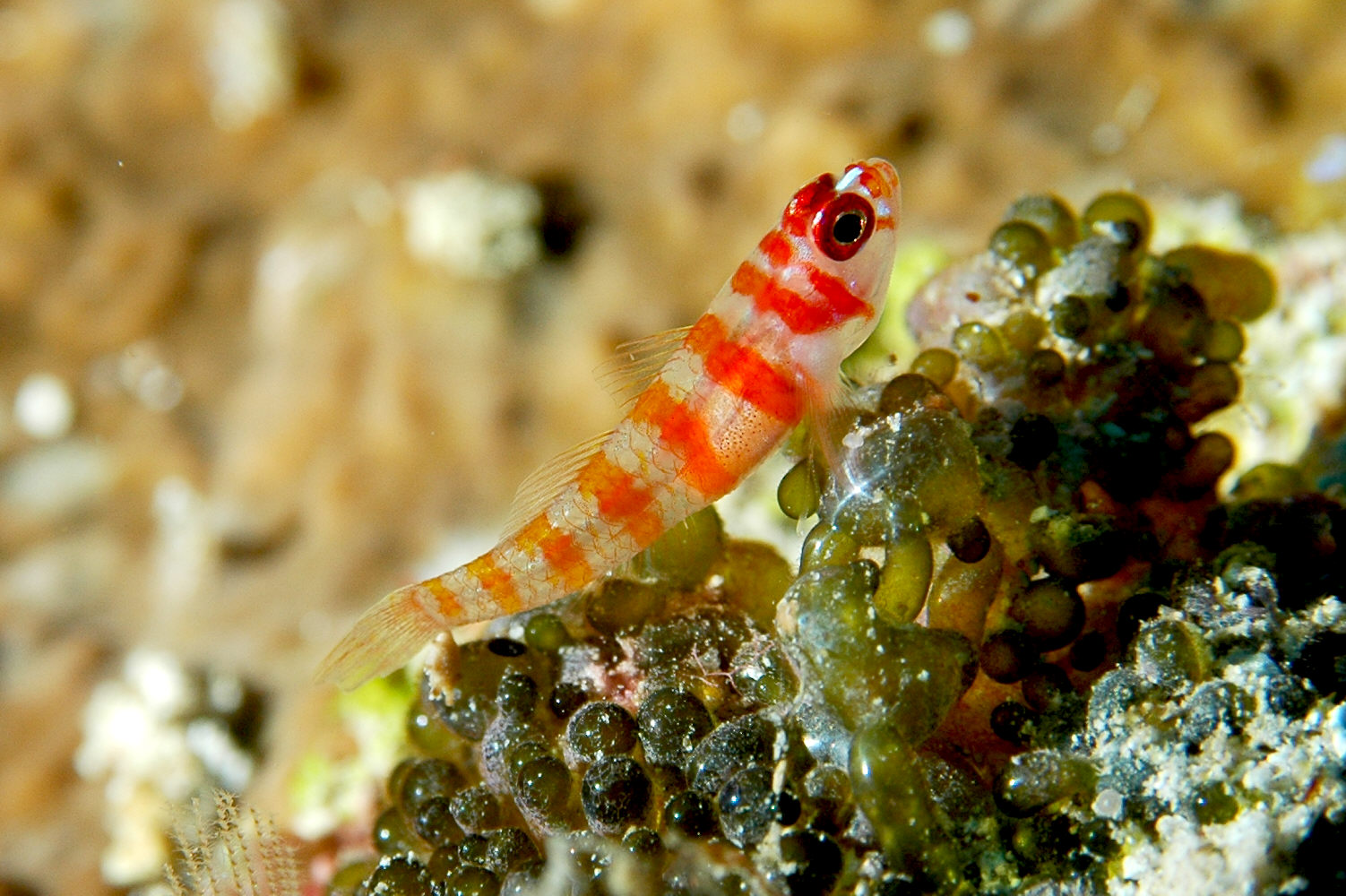
Summary: This informational book shows the actual size of a variety of animals. In the back of the book, Jenkins includes a full body picture (not at actual size) of each animal with a more elaborate description of each one. Animals range from the dwarf goby (world's smallest fish) to siberian tigers (largest of all cats).

Response: I am a very visual person and being able to compare the actual size of the animals in this book to my hands, eyes, teeth, etc. is so great! I remember looking through so many books and magazines about different animals and seeing pictures of them but I never knew what they looked like in real life until I went to the zoo and saw them in person. With this book, children can see how big an elephant's foot is, how big a giant squid's eye is, etc. without ever leaving their home or school! Don't get me wrong, zoo trips are amazing... but there isn't always an opportunity for those.

Jenkins is one of my favorite children's book illustrators. He makes collages of each illustration using cut and torn pieces of paper. On his website he goes through the process of making his books. There is also a video about how his book Move! was made. The paper he uses adds a lot of texture to the picture, especially if he uses torn edges. When reading through this book I find myself fascinated at the detail of the animals Jenkins illustrated. He doesn't leave out one razor sharp four inch tooth or any long, thin whiskers.

Teaching Ideas: This book would be great for use in a science lesson in the study of different types of animals. It could even be followed by a trip to the local zoo! After reading the book, students could find facts on their favorite animal that wasn't mentioned in the book and make their own 'actual size' animal with construction paper. These could be collected and made into a bulletin board entitled 'We're Actual Size!'.


My Impression of Nonfiction Texts:
I truly enjoy reading nonfiction books. To me they are among the most interesting books I have read. Fiction books produce great stories as well, but it easier to relate to books about something that has really happened or that is about a place you have visited. As for children, some informational texts might not appeal to them but for the most part I think they would enjoy them because of the real photographs or if it shows the actual size of something, such as animals.

Sunday, March 30, 2008

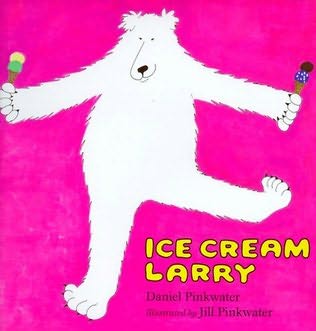
Ice Cream Larry


Author: Pinkwater, Daniel
Illustrator: Pinkwater, Jill
Publisher and Date: Marshall Cavendish, 1999
Genre: Picture Book
Age Range: K-2nd

Summary: This is about a polar bear named Larry who spends the night in an ice-cream shop named Cohen’s Cones. Mrs. Cohen is the owner of the ice-cream shop and let Larry sleep in the freezer because he said he was warm and she thought he wouldn’t eat any of the ice cream. Larry eats two hundred and fifty pounds of ice cream, but says that he does not feel sick. Mildred’s father pays for the ice cream Larry ate, as well as the almond crunch cones that Larry and Mildred got as they left the ice-cream shop. A man by the name of I. Berg comes to the hotel where Mildred and her family live, and asked for Larry. Mr. Berg is the owner of Iceberg Ice-Cream Company and meets with Larry, Mildred, and her father about Larry coming with him to Baltimore, Maryland where his ice cream factory is. Larry goes to visit the factory, and wouldn’t talk about what he did while he was there to Mildred or her parents. Larry and Mr. Berg continued meeting with one another, looking at sheets of paper and talking. One day Mr. Berg comes to the hotel with a large plastic foam box full of ice creams bars, each with a picture of Larry on the wrapper. They were called Larry Bars and came in vanilla, chocolate, strawberry, blueberry, artic almond, bearberry, polar pineapple, and codfish. Mr. Berg also had posters made and a billboard, all of which had Larry on them with their new slogan, “I do not feel sick!” written on them. Larry became a celebrity and the spokesbear for the Iceberg Ice-Cream Company. In return for his work, Larry received a new walk-in freezer in his room and fifty Larry Bars each day.

Response: I really enjoyed this book and actually was able to use it for another class in relation to a health lesson. It is somewhat obvious that I related it with nutrition, but I really like how easy it has been for me to find books like these that will go across so many other subjects. Relating the book to another subject can help the students relate to it better because they have already learned the material, or they will be able to relate to the material more after having read the book.

I liked how simple and lighthearted the story was. The illustrations are simplistic as well and the colors used by Pinkwater are vibrant and cheerful. Using a bright color scheme allows for a younger reader to stay interested in the book since what they mostly look at is the pictures.

Teaching Ideas: Have students to participate in a “Live Pyramid”. On the floor, mark a pyramid out on the floor using duct tape, dividing the pyramid into the food groups as displayed on the My Pyramid. Give each student a different photograph of a food out of the ones discussed in class earlier in the lesson. Examples of those foods may be: grapes, beans, fish, bread, milk, ice cream, celery, pork, etc. Students will then place themselves, one by one, into the food group where they think they belong and explain why they chose that food group. Encourage other students in the class to help one another place themselves in the correct group.

Friday, March 28, 2008

Cendrillon: A Caribbean Cinderella


Author: San Souci, Robert D.
Illustrator: Pinkney, Brian
Publisher and Date: Simon & Schuster Books for Young Readers, 1998
Genre: Picture Book, Traditional Tale, Multicultural
Age Range: K-3

Summary: In this Caribbean version of Cinderella, the story is told from the godmother's perspective. Cendrillon's mother passes away after giving birth to her. Her father married again, but this lady did not have any other daughters. Together they had one other girl whose name was Vitaline. Madame (her step mother) of course works Cendrillon like she is a servant girl and favors her own daughter over her. Cendrillon's godmother helps her get to the ball, changing breadfruit into a carriage, agoutis into horses, lizards into footmen, and a a manicou into a coachman. She meets Paul (Monsier Thibault's son) and danced with him until she had to return home by midnight. Paul came searching for her after the ball with the slipper she left behind and found her after her sister Vitaline tried it on without success. Cendrillon and Paul were married soon after he found her.

Response: I really liked this version of Cinderella as well! I think I'm a sucker for any type of fairytale, no matter what culture or story it tells! I thought it was so clever to tell the story from the perspective of the godmother, who was a poor washerwoman who scrubbed other people's sheets and shirts. There wasn't anything 'magical' about her except for the mahogany wand her mother left her when she passed away. Three taps of it could change one thing to another but the magic was to be used to help someone you love.

The illustrations fit the book so well! They were created with scratchboard, luma dyes, gouache, and oil paints. I feel like Pinkney was able to create a very beachy feeling throughout the book. The use of vibrant colors in the clothing of the people reflected the culture. All of the curves in the illustrations and the beach elements such as palm trees and the ocean create an excitement and really allow the pictures to flow to one another.

Teaching Ideas: This story would be good as a multicultural lesson. After reading or discussing the traditional Cinderella tale, students could compare it to this one. A list of traditions or things that are specific to the Caribbean culture could be listed for the students for them to notice the differences in culture between the stories. Students could also create a Venn Diagram to show similarities and differences in the two stories.

The Way Meat Loves Salt: A Cinderella Tale from the Jewish Tradition


Author: Jaffe, Nina
Illustrator: August, Louise
Publisher and Date: Henry Holt and Company, Inc., 1998
Genre: Picture Book, Traditional Tale, Multicultural
Age Range: K-3

Summary: In this Cinderella tale, Mireleh, the youngest daughter of three has a special place in her fathers heart. She, however, is sent away from her home by her father after telling him she loves him the way meat loves salt. She meets a stranger in the countryside who gives her a magic stick (it gives her anything she wishes for after tapping it on the ground three times) with the instruction to go to the home of Rabbi Yitskhok ben Levi. The Rabbi and his family take her in because of their conviction to help those in need. The next day the Rabbi and his family leave for a wedding feast which Mireleh desires to go to. She uses the stick to get a dress, pearls, and slippers for the wedding feast. She arrived in time for the celebration and catches the eye of the Rabbi's son. She left early to beat the family back home, her shoe getting stuck in the tar the son leaves outside the door in order that he might speak with her. He goes around the town trying to find the girl that fits the slipper, and Mireleh asks to let her try it when he returns home. They marry when he finds out it is her the slipper belongs to.

Response: I really enjoyed this version of the Cinderella story. It was pretty different from what I would have expected. I like how Elijah the Prophet was incorporated as the 'fairy godmother' of Mireleh. Elijah was very special to the culture in that he lead the people away from worshiping different gods. In the same way he was able to lead Mireleh to a Rabbi and his family that would take her in and which lead her to her "prince". I was glad that there wasn't an evil step-mother or any evil step-sisters in the story. It made the story more enjoyable even though it was the father who drove his youngest daughter out of their home.

The illustrations were beautiful and wonderfully done. The book says that they were prepared as linocuts painted in full-color oils on rice paper. The people are simply drawn and each illustration has vibrant colors. In the spread where Elijah is speaking to Mireleh you sense a more mystifying tone being set. I think each illustration is fitting to the story line and the media used along with the simplistic style creates a more traditional tone for the book.

Teaching Ideas: This story would be wonderful to use in a multicultural lesson. First, students could read the traditional story of Cinderella followed by this story. Facts about the Jewish culture could be stated on a handout or poster for everyone to see and students could compare the two stories and pick out the culturally specific traditions and items within the story.

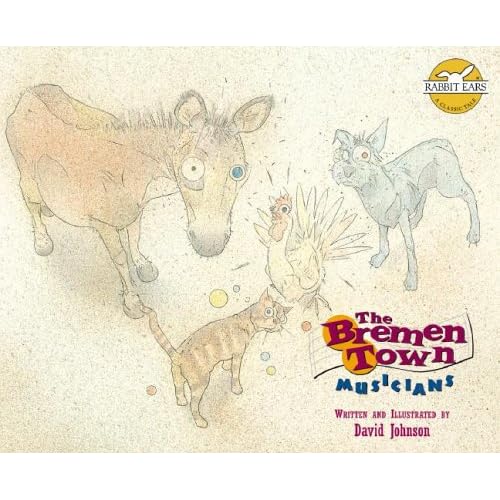
The Bremen Town Musicians


Author/Illustrator: Johnson, David
Publisher and Date: Rabbit Ears Productions, Inc., 1997
Genre: Picture Book, Traditional tale
Age Range: K-2nd

Summary: This version is retold from the Grimm tale. It is about an old donkey, a dog, a cat, and a rooster who are no longer wanted by their owners. One by one they join each other in heading to the town of Bremen to become musicians. The donkey sang, his voice resembling something between a snare drum and a saxophone, the dog sang bass, the cat sang harmony which sounded something like a violin or a rusted hinge, and the rooster sang in a voice sounding like something between a musical saw or a bagpipe. Once all together they came upon a house full of thieves who were eating a meal together. The animals come up with a plan to serenade the thieves for some food. As they begin to sing, they crash through a window into the parlor of the house which scares the thieves and they run out of the house. The thieves attempt to return to their house to reclaim it. One thief went back to check it out, but when he entered he startled the animals who attacked him. He went back and told his other thief friends how awful it was and they gave up their careers as thieves and moved to Venice to form a singing group. The animals remained at the house, where the practiced their songs each day.
Response: I thought this book was absolutely adorable. It somewhat reminded me of The Wizard of Oz when Dorothy, the Scarecrow, the Tin Woodman, and the Cowardly Lion are all on their way to Emerald City to see the Wizard of Oz. Each character has their own unique quality (or singing ability!) that contributes to the group. In the book, they never reach Bremen Town which I think could be represented by Emerald City or even the Wizard. The Wicked Witch of the West I think could be portrayed by the thieves in the house that the animals come across. The Wicked Witch did all she could to keep the friends from getting to Emerald City, but they did make it. In the book, the animals' last stop is the house and the reader never knows if they actually reach Bremen Town where they wanted to go be musicians.

I really enjoyed the illustrations in this book. They look a little kooky as you can tell by the book cover. Their eyes are different sizes and colors and they just look so frazzled. Its no wonder their owners did not want them any longer. I couldn't find what media were used for the illustrations, but it reminded me of those blow pens I used to get when I was a kid. It was basically just a marker that was designed so you could blow one end of it and dots of color would sprinkle onto the page in no particular order. The would come with stencils and such so you could make different designs with them. It looks similar to airbrushing.

Teaching Ideas: This book would be wonderful as a music lesson. Students could be grouped together in fours (or however many the amount of students would allow) to compose their own "Bremen Town Melody" to play for the rest of the class. Each student could pick out their own instrument to play and could describe what kind of animal it would represent.
For a Language Arts lesson, students could write a short ending to the story and draw and simple picture to show what would happen if they animals in this book had continued on to Bremen Town. A bulletin board could be put together of their work to display their creative writings.

Sunday, March 16, 2008

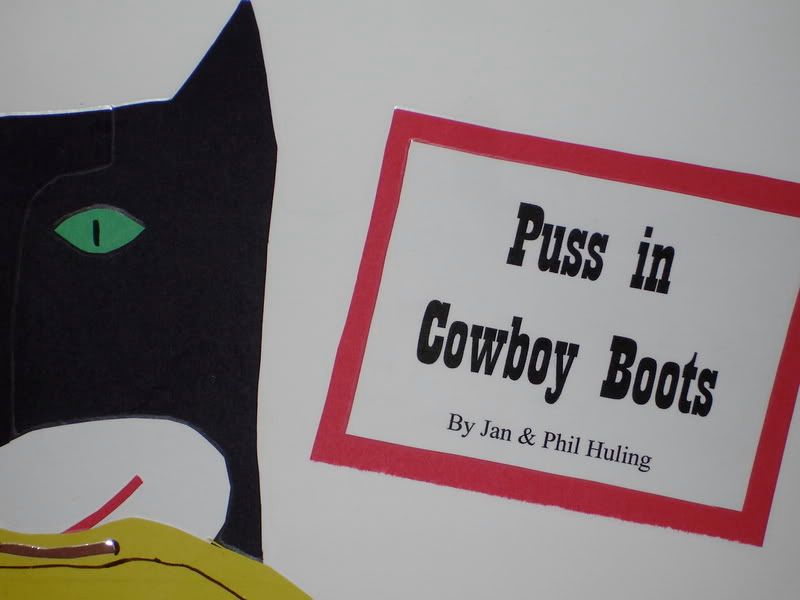
Puss in Cowboy Boots


Author: Huling, Jan
Illustrator: Huling, Phil
Publisher and Date: Simon & Schuster Books for Young Readers, 2002
Genre: Traditional Literature, Picture Book
Age Range: 1st-3rd grades

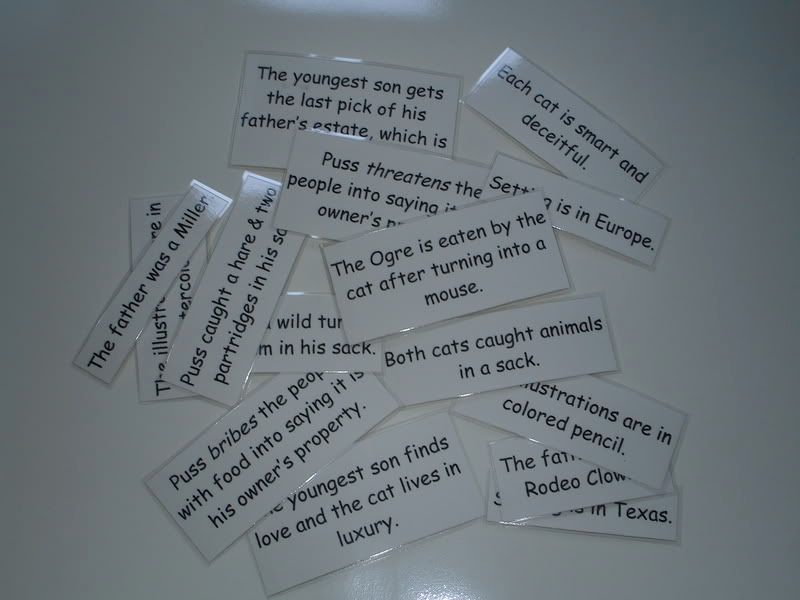
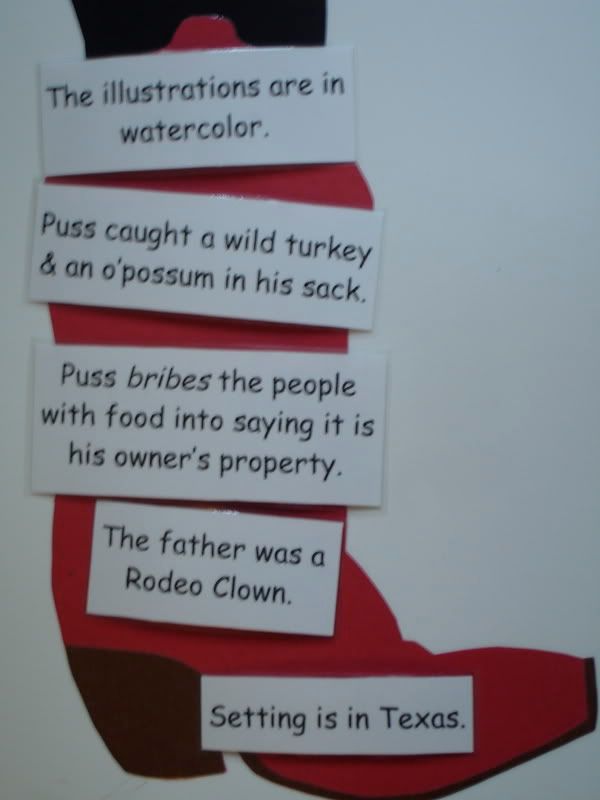
Summary: This version of Puss in Boots is in a Western setting. The rodeo clown father passes away, leaving his sons three items. The youngest son get stuck with the cat and isn't too happy about it. The cat tells the son to get him some boots and a sack, and so he does just that figuring he had nothing to lose. Puss catches animals and takes them to Mr. Patoot, the most powerful oilman in the state of Texas, to impress him. One day Puss and Rancher Dan (the youngest son) go to the creek by the road to swim. Puss calls out to Mr. Patoot as he drives by to help because Dan is drowning and has no clothes. Dan is rescued and rides with Mr. Patoot and his daughter in the country side. Puss goes ahead of them bribing the cowboys with their cattle and workers at the oil rigs with bar-be-que to tell Mr. Patoot that it all belongs to Dan. Puss also convinces the Ogre to turn into a mouse and gobbles him up in order to tell Mr. Patoot that the ranch house belonged to Dan as well. Mr. Patoot is very impressed with all of his estate as well as his daughter, Rosie-May. They had a big shindig with bar-be-que, fireworks, and music and Rosie-May promised to be Dan's bride. Puss was content in his work and enjoyed his sardines and sweet cream.

Response: I loved this Western style of the traditional story. The main idea of the story stayed in-line with the traditional version, but the details made it so much more modern. I like how the Hulings were able to take the story and adapt it to a Texan point of view where everything is 'bigger'. With the illustrations the people seem really tall. The same is with the animals, especially the cat. I've never seen a cat quite that large, especially on the page where Puss is sitting down at the feet of the Ogre.
I really enjoyed the simplicity of the watercolor illustrations. I think it goes along with the theme very well in that people out in the Southwest part of the United States are thought of to be cowboys and ranchers, sometimes rather simple minded. Thats not to be a cut down on their intelligence, but just the fact that they tend to be more laid back and very personable people. The color scheme in the whole book more or less consists of warm colors like yellows, reds, oranges, and browns. These colors are also related to the West and desert type areas because the climate is hot and humid.

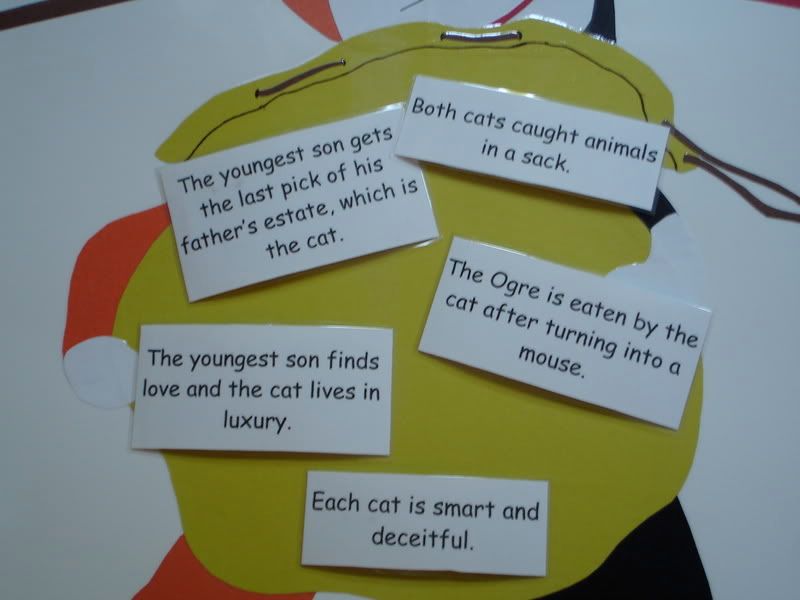
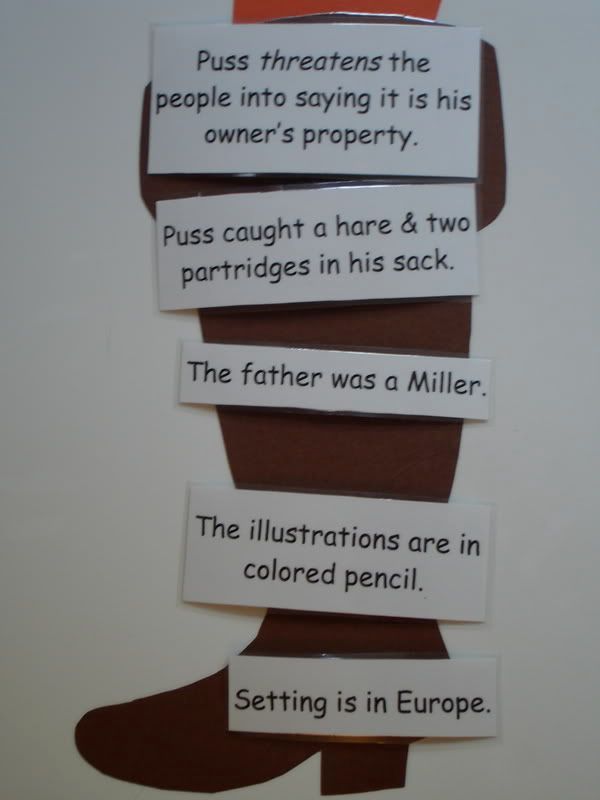
Teaching Ideas: Use this story in comparison to the traditional version of Puss in Boots. Make a Venn Diagram to compare the two and have the students participate in organizing the information on it. Also, students could create their own version of Puss in Boots or another traditional tale, adapting it to a different culture or make it specific to them.


From Jan Huling:


Hi Dani -

Thank you so much for choosing to write about "Puss", you made my day! I love the Fred Marcellino version, too, and used to read it to my son all the time. Now I collect Puss in Boots and have versions from Russia, China, Greece, Spain, even a teeny tiny one I found in Paris! It's a great story, one I tried to make a little sweeter (by having Puss bribe the field hands
instead of threatening them) and funnier (by using broad Texan stereotypes, hopefully not in a mean way).
Of course I adore the illustrations, Phil and I had exactly the same vision of what Puss should look like.

I hope you'll keep yer eyes peeled for my next book, "Ol' Bloo's Boogie-Woogie Band and Blues Ensemble" which is supposed to be out this fall from Peachtree Publishers. It's another southern fried take on a classic fairy tale, the Brementown Musicians which is a really, really funny story in the first place. Phil's not illustrating this one (too much strain on a very happy marriage!) and I haven't seen anything yet, so I'm just keeping my fingers crossed.

By the way, I'd never heard of a Venn Diagram, but yours is a beauty!

Thanks again!
xoxo
Jan

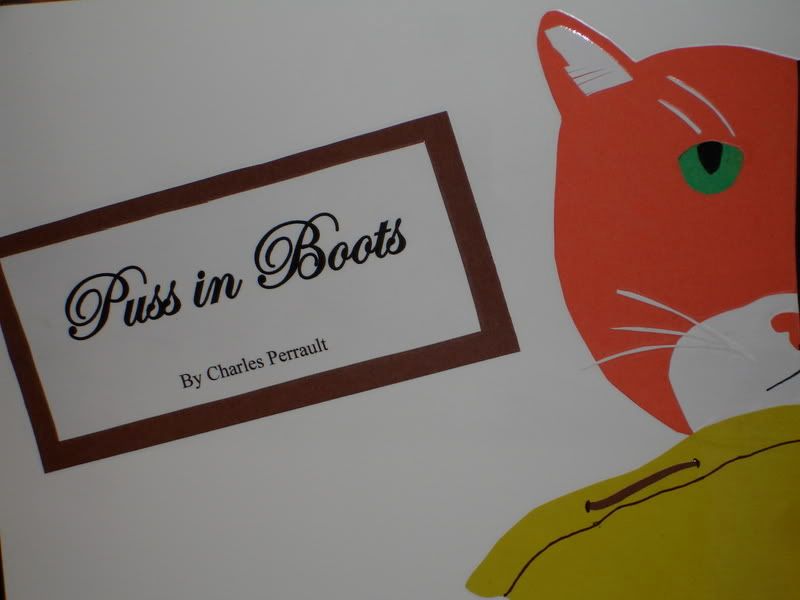
Puss in Boots


Author: Perrault, Charles
Illustrator: Marcellino, Fred
Publisher and Date: Michael di Capua Books, 1990
Genre: Traditional Literature, Picture Book
Age Range: 1st-3rd Grades
Awards: Caldecott Honor Book 1991

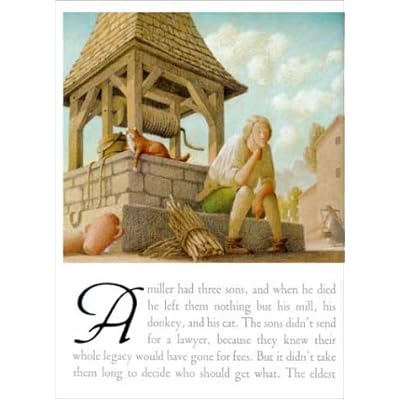
Summary: In this traditional tale a cat is left to the youngest of three sons after the passing of the father. The son considers killing the cat to eat and use it's fur to make a muff. The cat did not like this idea and convinced its owner to get him a pair of boots and a sack. The cat catches animals in the sack and takes them to the King to impress him. One day as the King was riding in his carriage, he rode by the river where the cat and his owner (Marquis of Carabas) were going for a swim. The cat tells the King his owner is drowning and is without clothes so the King has Marquis of Carabas rescued and clothed and he rides with the King. Puss goes ahead of the carriage and threatens peasants mowing a meadow and some harvesters into telling the King when he came by that Marquis of Carabas owned the land and crops. Puss also tricks the Ogre into turning into a mouse and eating him so that Marquis of Carabas could claim his castle as well. The King is impressed by Marquis of Carabas' large estate and takes the Kings daughter as his wife while Puss lives in luxury.

Response: I had never read the tale of Puss in Boots before. All I knew was from Shrek 2 and I am not a big fan of the Shrek movies, so even my knowledge of that was rather limited. I am not really sure what I expected from the story but I feel like the story turned out to be very different from what I might have anticipated. I was kind of confused at the beginning as to why the miller's youngest son was not shocked that the cat could talk.

I loved how Marcellino portrayed the characters in his illustrations. One of my favorite spreads in the book is the very first opening pages. This is where the youngest son is talking about killing his cat to eat it and make a muff out of the fur. The cat is sitting behind the son on the well and the expression on its face is so funny! I can honestly say it made me laugh. Its as if you can tell the cat is trying to come up with a clever plan so he won't be dinner for his owner. I think Marcellino also does a good job with keeping the illustrations relative to the time period, especially with the clothing styles.


Teaching Ideas: Use this book in comparison to another version of the same tale. Introduce Venn Diagrams and have the children participate in deciding which parts go along with this book and which go along with the next which is in the blog above this. [Pictures of Venn Diagram are also above.]

Saturday, March 15, 2008

Lon Po Po: A Red-Riding Hood Story From China


Author/Illustrator: Young, Ed
Publisher and Date: Philomel Books, 1989
Genre: Traditional Literature, Picture Book
Age Range: 2nd - 5th grades
Awards: Caldecott Award Winner 1990

Summary: In this version of Red-Riding Hood, three sisters are left at home alone one night while their mother left to go see their grandmother, Po Po, on her birthday. An old wolf disguises himself as Po Po after the mother leaves and is let into the house by the two younger sisters. The oldest sees the wolf's face and comes up with a plan involving the ginkgo tree to kill the wolf so they will be safe again.

Response: I really enjoyed this version of Red-Riding Hood. It is so different but still shares some similarities with the one I heard when I was growing up. In this one the "grandmother" comes to the house instead of being sick in bed and it has three little girls instead of one in a red cape. I liked how the three girls outsmarted the wolf on their own by dropping him in the basket from the tree. It was a clever plan that did not need the assistance of a woodsman passing by!
The girls tell the wolf that if he eats one gingko nut, that he will live forever. I wasn't sure what that was so I looked it up and it is linked above. According to Wikipedia it is misspelled, but I doubt it makes too much of a difference. On that linked site it shows pictures of the ginkgo trees which usually range from 66-115 feet. That wolf had three pretty hard falls from a tree that tall! There is some truth to living forever though, as the nuts are believed to have health benefits in the Chinese culture.

Teaching Ideas: This is a great book to compare cultures with. Elements such as the ginkgo nuts and 'Po Po' could be discussed and students could relate them to a similar item in their culture. A Venn-Diagram could also be created comparing this version with the traditional story of Red-Riding Hood. As a language arts lesson, students could get into small groups to create their own version of Red-Riding Hood and share it with the class.

Swamp Angel


Author: Isaacs, Anne
Illustrator: Zelinksy, Paul O.
Publisher and Date: Dutton Children's Books, 1994
Genre: Traditional Literature, Picture Book
Age Range: 1st - 4th grades
Awards: Caldecott Honor 1995

Summary:
Angelica Longrider, also known as Swamp Angel, was a large girl from birth. She came to the recuse of many people in Tennessee when they needed help. One summer she wrestled with a bear named Thudering Tarnation in order to help with the winter supplies of the settlers in Tennessee. After Angel managed to kill the bear, all the people in Tennessee were fed and the leftovers were stored up just in time for winter.

Response: What I liked most and noticed first about the book were the illustrations. They are oil paintings on cherry, maple, and birch veneers. Zelinsky was creative with it and came up with a style that fit the story of Swamp Angel. It takes place in Tennessee where the people are settling the area. It makes me picture open fields surrounded by woods with a line of log houses, so it makes sense to me for the pictures to be painted on wood.
The big bear constellation is explained by Swamp Angel throwing the bear up so high into the sky. The reader later learns that the bear crashed into a pile of stars, making an impression in them. Ursa Major is the true name of it and the Big Dipper is part of it.
I really liked how the Great Smoky Mountains came about according to this story. I think it is something children in this area especially would be able to relate to well. A lot of people visit them frequently or have even lived there so they would know what they look like, having been there.
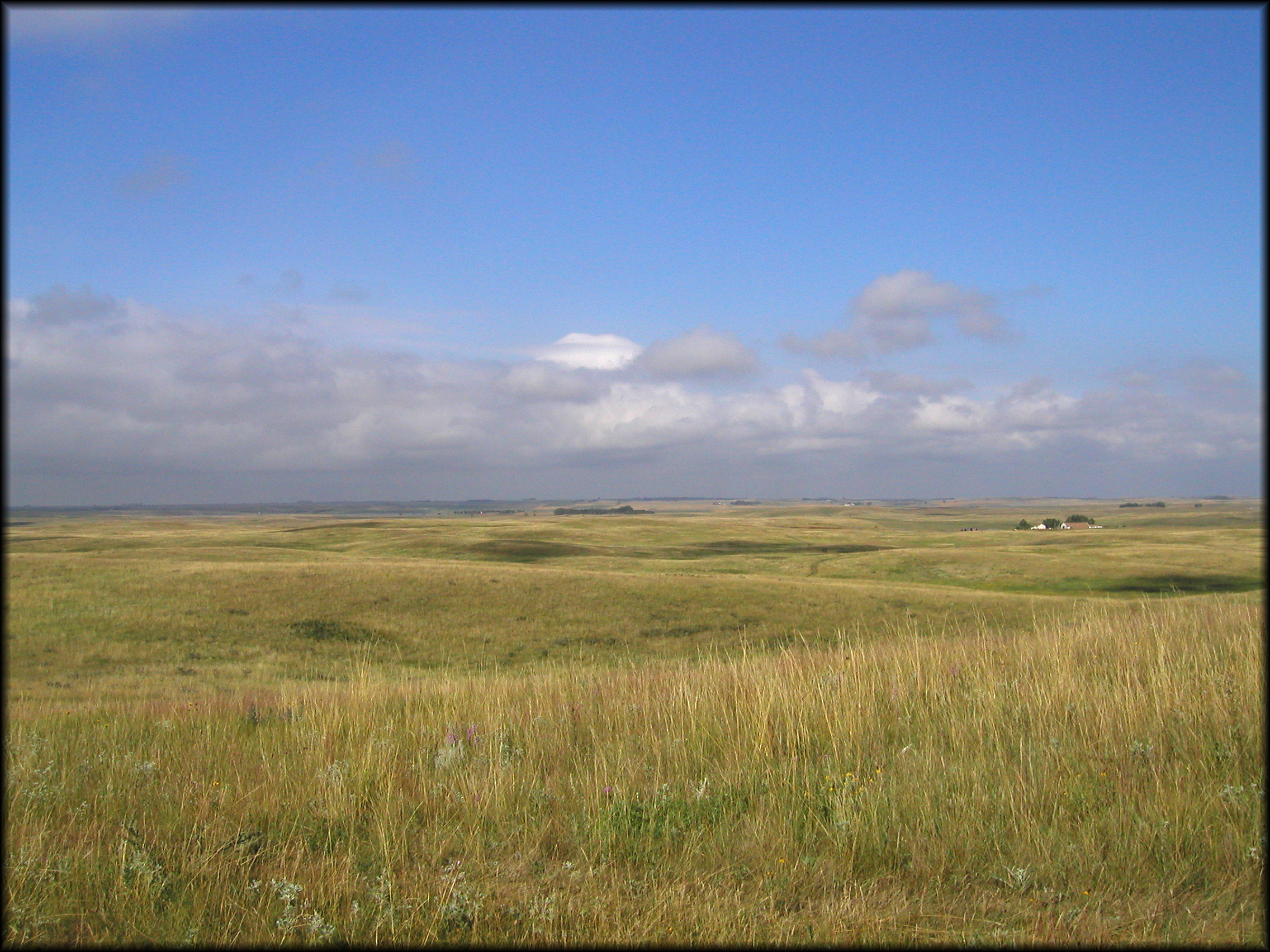
At the end, Swamp Angel takes Thundering Tarnation's pelt out to Montana as a bear rug in front of her cabin. The place where she moved the pelt is known as the Shortgrass Prarie. I haven't learned anything about the Shortgrass Prairie before, so I Googled it and found all sorts of interesting sites, one of which I linked below. I think it is good to include unfamiliar items in a book to spark a students' interest in it and get them to find out more information about it.

Teaching Ideas: This story could be incorporated into a Language Arts and Geography Lesson. Students could create their own tall tale to explain why something is the way it is. (for example - how Grandfather's Mountain came to be; the face in the mountain) They could also look up different types of land throughout the United States, focusing first on the Shortgrass Prairie. Sites like the one I just linked could be used by the students to gather information on the types of animals and plants that are found there.

Sunday, February 24, 2008

Tuesday


Author/Illustrator: Wiesner, David
Publisher and Date: Houghton Mifflin Company 1991
Genre: Wordless Picture Book, Fantasy
Age Level: K-3
Awards: The Caldecott Medal

Summary: Tuesday is a story of a large number of frogs who are set free one Tuesday evening, soaring around town on their lily pads. They leave their home at the swamp, and fly through a nearby neighborhood. The frogs stir up a lot of commotion and leave the town scratching their heads. In the morning they return safely to their home at the swamp. The next Tuesday, some pigs have their chance to fly.

Response: I LOVED this book! I was a little skeptical of wordless picture books, but I gave this one a chance since it had won a Caldecott Medal. I enjoy the fact that the narration, which is left up to the reader, is simply guided by the illustrations. This leaves all the creativity in the story up to the reader. There are so many different things younger children could come up with, from reasons why the frogs are flying where they are to what they are even thinking. I would like to be able to challenge my students to think creatively by 'reading' through this story.

My favorite page in the book is where the man is sitting in his kitchen having a sandwich and a glass of milk. The expression on his face just makes me laugh. What adds to it is one of the frogs flying by his window, which appears to be smiling and waving at him like nothing is out of the ordinary.

On Wiesner's website it shows how he created Tuesday. I wouldn't think that a picture book would being with a story board sketch, but that is exactly what he did with it. It looked like a small comic strip at first and then he put it into its chronological order. After he had the story line he created a rough sketch in pencil of each page. In order to get an idea of the correct lighting, he used clay models and photographs of frogs, homes and other key elements to the drawings. The finished drawing was done on tracing paper, transferred to watercolor paper, then painted with all watercolor.

All of the illustrations in this book were created using watercolor and watercolor alone. Wiesner did not use any ink lines or any other type of opaque paint. I really admire that. I was never an artist, but I had a few art classes in high school and we used watercolor for one of our projects. It is not easy to work with and you can't really hide your mistakes. Once the color is down, it is there. In the project I did it turned out perfectly except for a little smudge in the white space. I had to create a dove holding an olive branch in its mouth to cover it up and had to use an ink pen to do it. I'm sure the more skilled you are the easier it is to execute a painting with only watercolor. Wiesner did a wonderful job with it.

Teaching Ideas: This book would be great to use as a creative writing activity. Students could write down what they think is going on and write down the thoughts of the characters illustrated throughout the book. They could also be encouraged to write or draw out what they think will happen when the pigs fly around the next Tuesday night. Have them show where the pigs go, what they do, and who they might encounter. Another way to get the students more involved is to have them draw out their own story, following the guidelines of a wordless picture book, like Tuesday.

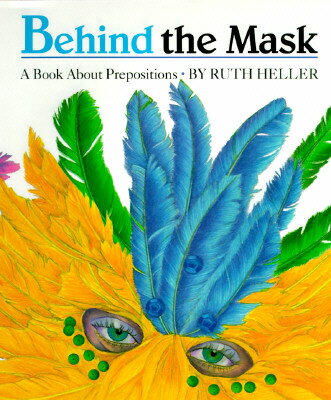
Behind the Mask - A Book About Prepositions


Author/Illustrator: Heller, Ruth
Publisher and Date: Scholastic 1995
Genre: Concept Picture Book, Informational, Poetry
Age Range: 2nd-5th grades

Summary: This is a very informative book on what prepositions are and some proper uses for them. The prepostitions used are made distinct by their bold blue font. The book captures the reader with vibrant illustrations as well as its rhymes.

Response: I really enjoyed reading through this book. The information is presented to the reader in an informal manner, making it fun and easy to learn. I liked how the author incorporated other children's stories into this book. This makes it easier for students to relate and get into the book because it includes something they are already familiar with. One of my favorite pages was the the spread of Jack and Jill. The page reads, "Be angry with a person, but angry at a thing. I'm angry with Jack and I'm angry with Jill... but, I'm angrier still at the pail and the hill." Students learn without even realizing it, because they are seeing some of their favorite storybook characters.

This book not only lists several prepositions throughout the book but adds in rules about the proper usage of them. For example, using two prepositions is not always better than using one. They are also okay to use at the end of a sentence, but it might not always be the best way to word the sentence.


Teaching Ideas: This book, of course, would be perfect to use as part of a Language Arts lesson. It also could be made avaiable to students throughout the day if they finish assignments early. I think students would enjoy this book with its rhymes and pcitures, but also with its educational content.

Baseball Saved Us


Author: Mochizuki, Ken
Illustrator: Lee, Dom
Publisher and Date: Lee & Low books Inc. 1993
Genre: Historical Fiction
Age Range: K-3
Awards: 1993 Parents Choice Award

Summary: This is a story told by a little Japanese American boy whose family was taken away to an internment camp. He doesn't understand why the other kids at school made fun of him or why they have to stay in a dusty camp that isn't fun. The boy's dad comes up with the idea to build a baseball field in the middle of camp and they have a tournament. At the end, the boy is back at school where he was before the camp and they are playing baseball. People still make fun of him but his teammates encourage him and he hits a home run.

Response: I have never learned much about the Japanese Internment camps that were set up in the middle of the American deserts. This book taught me some of what it might have been like for those who were taken away from their homes to live there. The author's note in the beginning was very helpful in providing the background information for the time and setting of the story.

On the second page of the story it tells how the boy was taken out of school one day because him and his parents had to move out of their house really quickly. It tells how a bus took them away to a place where they had to live in horse stalls until they got to the camp. I can understand trying to protect our country from people who could potentially do a lot of harm to it, but that is just ridiculous to me. It is awful to think that we put our own people in situations like that. I can't imagine what I would think or do if my own country turned its back on me.

Teaching Ideas: This story would be good to use when talking about discrimination and even bullying. Students would probably be able to relate it most to the events of 9/11 and how we, as Americans, tend treat people of Middle-Eastern descent now. It is a terrible situation to be in, but we have to move on and not hold people accountable to how others have wronged us just because they look alike. I think it goes back to Because of Winn-Dixie where Gloria Dump tells Opal not to judge other people because of their past but to look at what they're doing now. In this case it isn't necessarily a specific person's past but the events of the past.

Saturday, February 2, 2008

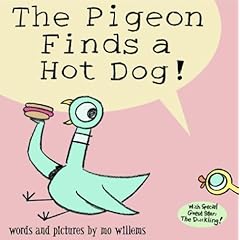
The Pigeon Finds a Hot Dog!


Author/Illustrator: Willems, Mo
Publisher and Date: Hyperion Books for Children 2004
Genre: Picture Book
Age Range: K-1

Summary: In this book a pigeon finds a hot dog and is approached by a little duckling. The duckling keeps questioning the pigeon about the hot dog while the duckling takes notes. The pigeon gets annoyed and doesn't want to share the hot dog because he is the one that found it. In the end they split the hot dog and sit down to eat it together.

Response: I really liked the unique drawings of both birds in this book. Their eye takes up the majority of their head and the expression is shown by how much of the eyelid covers the eye.
The relationship between the two birds reminds me of that between an older and younger sibling. I am the younger sibling and have always been very inquisitive. My sister, on the other hand, did not always enjoy answering all of my questions all of the time. And though we are nine years apart, she still did not always want to share her things with me.

Teaching Ideas: This book would be good for a lesson on compromise and sharing with others. The duckling obviously wanted a taste of the hot dog and the pigeon obviously did not want to share its delicious hot dog with anyone else, especially the duckling. In the end they split the hot dog in half and each were able to eat some. This can teach children that even though they may not want to always share something with someone else, it is the polite and right thing to do.

Knuffle Bunny Too


Author/Illustrator: Willems, Mo
Publisher and Date: Hyperion Books for Children 2007
Genre: Picture Book
Age Range: K-1
Awards: 2008 Honor Book

Summary: This picture book is about a girl named Trixie who was excited to show her Knuffle Bunny to her friends at school. When she got to school she saw that another girl, Sonja, had the same Knuffle Bunny. Their Knuffle Bunnies got switched after the teacher had taken them away and the girls had their fathers switch them in the middle of the night. After the bunnies were returned to their rightful owners, Trixie and Sonja became best friends.

Response: I can relate so well to this book! I know it was absolutely awful to show up at school with the same anything as another kid in the class. After that happens though, you realize you have something in common with the other person and it usually would end in a friendship unless one of the children was a real bully!
Willems did an excellent job with the illustrations in this book. I loved how the background of the picture was a black and white photo and the characters were illustrated. The lighting from the photo was reflected in the illustrated characters, which really pulled the whole picture together. In the picture where Trixie's dad is talking to Sonja's on the phone, Trixie's dad is standing in front of a mirror and his reflection is drawn in on the mirror of the black and white photo. I think the pictures were my favorite part, I love it when artists mix mediums.
I liked how Willems was able to incorporate aspects of his other books into Knuffle Bunny Too. In the picture where Trixie's parents are putting her to bed she has a stuffed animal at the end of her bed which is actually Leonardo The Terrible Monster from one of his other picture books. This reminded me of the Pixar movies, Monsters Inc. and Finding Nemo. In Monsters Inc., the litter girl, Boo, has a fish mobile in her bedroom. In Finding Nemo, Pixar placed that mobile from Boo's room in the dentist office when Nigel, the pelican, flies into the office. [I've included pictures below and circled the mobile in red!]


Teaching Ideas: This would be good for encouraging the children to make new friends and find people they have things in common with. It is also good in talking polite manners and how to share your things with others.

Friday, February 1, 2008

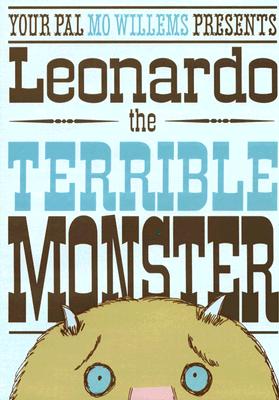
Leonardo the Terrible Monster


Author/Illustrator: Willems, Mo
Publisher and Date: Hyperion Books for Children 2005
Genre: Picture book
Age Range: K-2

Summary: This picture book is about a discouraged little monster named Leonardo. He is not good at scaring like the other monsters. After much research he finds a boy named Sam to scare. Sam is having a bad day and is not scared by Leonardo. Leonardo decides to become a friend to Sam instead of being a terrible monster.

Response: I love the story of Leonardo the Terrible Monster! The illustrations were very well done and it reminded me somewhat of Where the Wild Things Are.
I think the story does good with the underlying theme of bullying. Most kids who are bullies do so because they are insecure about themselves just as Leonardo was. They feel better if they can pick on someone else and make them feel bad or upset. I like how in the end Leonardo and Sam become friends because Leonardo realizes that is really what Sam needs.
Something that made me laugh was the expression 'scare the tuna salad out of him' that Willems used in this book. It is just such a silly expression and it adds a lightheartedness to the story.

Teaching Ideas: This would be a great story to read any time to the class throughout the year. Bullying is an issue that never really dissipates among children and should be addressed, especially in younger grades. Children in the class could be challenged to make a new friend (like Leonardo made friends with Sam) or to make up with someone they did or said something mean to.