Showing posts with label Historical Fiction. Show all posts

Sunday, February 24, 2008

Baseball Saved Us


Author: Mochizuki, Ken
Illustrator: Lee, Dom
Publisher and Date: Lee & Low books Inc. 1993
Genre: Historical Fiction
Age Range: K-3
Awards: 1993 Parents Choice Award

Summary: This is a story told by a little Japanese American boy whose family was taken away to an internment camp. He doesn't understand why the other kids at school made fun of him or why they have to stay in a dusty camp that isn't fun. The boy's dad comes up with the idea to build a baseball field in the middle of camp and they have a tournament. At the end, the boy is back at school where he was before the camp and they are playing baseball. People still make fun of him but his teammates encourage him and he hits a home run.

Response: I have never learned much about the Japanese Internment camps that were set up in the middle of the American deserts. This book taught me some of what it might have been like for those who were taken away from their homes to live there. The author's note in the beginning was very helpful in providing the background information for the time and setting of the story.

On the second page of the story it tells how the boy was taken out of school one day because him and his parents had to move out of their house really quickly. It tells how a bus took them away to a place where they had to live in horse stalls until they got to the camp. I can understand trying to protect our country from people who could potentially do a lot of harm to it, but that is just ridiculous to me. It is awful to think that we put our own people in situations like that. I can't imagine what I would think or do if my own country turned its back on me.

Teaching Ideas: This story would be good to use when talking about discrimination and even bullying. Students would probably be able to relate it most to the events of 9/11 and how we, as Americans, tend treat people of Middle-Eastern descent now. It is a terrible situation to be in, but we have to move on and not hold people accountable to how others have wronged us just because they look alike. I think it goes back to Because of Winn-Dixie where Gloria Dump tells Opal not to judge other people because of their past but to look at what they're doing now. In this case it isn't necessarily a specific person's past but the events of the past.

Saturday, February 2, 2008

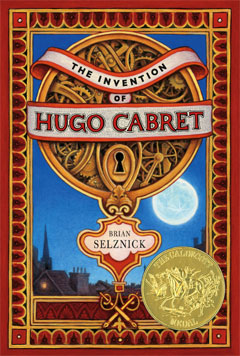
The Invention of Hugo Cabret


Author/Illustrator: Selznick, Brian
Publisher and Date: Scholastic Press 2007
Genre: Illustrated Novel, Historical Fiction
Age Range: 4-6 grades
Awards: Caldecott Award Winner 2008

Summary: This book is about an imaginative young orphan boy named Hugo Cabret who lives behind the walls of a train station in Paris. He steals from local shops to survive keeps the clocks running to cover the disappearance of his uncle. Hugo's stealing brings him in the path of a famous magician and filmmaker, Georges Méliès who has tried to shut his past out of his life. Hugo is able to help bring Méliès' past back to life and Méliès gives Hugo a home and a family.

Response: I absolutely loved this book! Selznick's illustrations are so detailed and captivating, it made the book seem like a movie with subtitles. I like how it tells the reader to picture yourself in a theatre before the movie starts. It brought that type of anticipation and had me trying to guess what would happen next.
The description in the book was very well done! I loved the pages that described the automaton. It made me feel like I was right there watching it draw out the picture of the man on the moon with the rocket in it's eye.
I enjoyed the incorporation of actors, movies, and machines of the time. It made the story more realistic and had you learning some history without digging into a history book.

I liked the extra information Selznick included at the back of the book. A link he provided shows a video of an automaton in action. I also looked up some of Méliès' movies on the internet and found a video of A Trip to the Moon on youtube. It is in French, but it is still really neat to see the actual film.

Teaching Ideas:
This book could be used as a lesson on the time period and the people that lived in it. Also could be used in an art or film lesson and look at works from that time period and how they differ from more contemporary works. For a more hands-on activity the children could draw or make out of clay their own automaton and write a story about what they would have it to write or draw. They could also reenact the movies mentioned in the book from their perspective. These could all be performed in front of the class as their own 'Georges Méliès' rememberence day.

Wednesday, January 30, 2008

Moses: When Harriet Tubman Led Her People to Freedom


Author: Weatherford, Carol Boston
Illustrator: Nelson, Kadir
Publisher and Date: Hyperion Books for Children 2006
Genre: Picture Book, Historical Fiction, Multicultural
Age Range: K-3
Awards: Caldecott Honor Book, Coretta Scott King Book Award for Illustration

Summary:This book gives the reader an idea of what the life of Harriet Tubman was like. In the foreword it describes slavery for any readers who may not know, and in the author's note it gives more of Harriet's story. The story takes you throught the journey of an African American female slave who escapes to freedom with guidance from God. Once free, she returns back to the south, risking her capture, to help lead other slaves to freedom.

Response: I really enjoyed reading this book with its beautifully detailed illustrations. I liked how the author put a lot of emphasis on Harriet's faith and how she trusted God to lead her. Through that I think it can teach children to have faith, if not in God then in themselves and also to believe in themselves. Something that stood out to me was Weatherford's use of font sizes and colors to distinguish between the narrative text, Harriet's words/thoughts, and God's words to Harriet. I think by making God's words lighter and in some cases in a curved form, it gave the impression that God was speaking to her heart and not in an actual audible sense.

Teaching Ideas: The first thing that came to mind was to use this book during Black History Month. Harriet Tubman had such a strong impact on the issue of slavery in the south and could be used as an example of how to have faith and persevere. There is also a big historical reference included in the book as well. You could compare the similarities of Moses and Harriet Tubman as well as the differences.