Sunday, March 30, 2008

Ice Cream Larry


Author: Pinkwater, Daniel
Illustrator: Pinkwater, Jill
Publisher and Date: Marshall Cavendish, 1999
Genre: Picture Book
Age Range: K-2nd

Summary: This is about a polar bear named Larry who spends the night in an ice-cream shop named Cohen’s Cones. Mrs. Cohen is the owner of the ice-cream shop and let Larry sleep in the freezer because he said he was warm and she thought he wouldn’t eat any of the ice cream. Larry eats two hundred and fifty pounds of ice cream, but says that he does not feel sick. Mildred’s father pays for the ice cream Larry ate, as well as the almond crunch cones that Larry and Mildred got as they left the ice-cream shop. A man by the name of I. Berg comes to the hotel where Mildred and her family live, and asked for Larry. Mr. Berg is the owner of Iceberg Ice-Cream Company and meets with Larry, Mildred, and her father about Larry coming with him to Baltimore, Maryland where his ice cream factory is. Larry goes to visit the factory, and wouldn’t talk about what he did while he was there to Mildred or her parents. Larry and Mr. Berg continued meeting with one another, looking at sheets of paper and talking. One day Mr. Berg comes to the hotel with a large plastic foam box full of ice creams bars, each with a picture of Larry on the wrapper. They were called Larry Bars and came in vanilla, chocolate, strawberry, blueberry, artic almond, bearberry, polar pineapple, and codfish. Mr. Berg also had posters made and a billboard, all of which had Larry on them with their new slogan, “I do not feel sick!” written on them. Larry became a celebrity and the spokesbear for the Iceberg Ice-Cream Company. In return for his work, Larry received a new walk-in freezer in his room and fifty Larry Bars each day.

Response: I really enjoyed this book and actually was able to use it for another class in relation to a health lesson. It is somewhat obvious that I related it with nutrition, but I really like how easy it has been for me to find books like these that will go across so many other subjects. Relating the book to another subject can help the students relate to it better because they have already learned the material, or they will be able to relate to the material more after having read the book.

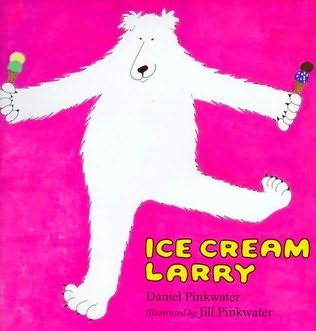
I liked how simple and lighthearted the story was. The illustrations are simplistic as well and the colors used by Pinkwater are vibrant and cheerful. Using a bright color scheme allows for a younger reader to stay interested in the book since what they mostly look at is the pictures.

Teaching Ideas: Have students to participate in a “Live Pyramid”. On the floor, mark a pyramid out on the floor using duct tape, dividing the pyramid into the food groups as displayed on the My Pyramid. Give each student a different photograph of a food out of the ones discussed in class earlier in the lesson. Examples of those foods may be: grapes, beans, fish, bread, milk, ice cream, celery, pork, etc. Students will then place themselves, one by one, into the food group where they think they belong and explain why they chose that food group. Encourage other students in the class to help one another place themselves in the correct group.

Friday, March 28, 2008

Cendrillon: A Caribbean Cinderella


Author: San Souci, Robert D.
Illustrator: Pinkney, Brian
Publisher and Date: Simon & Schuster Books for Young Readers, 1998
Genre: Picture Book, Traditional Tale, Multicultural
Age Range: K-3

Summary: In this Caribbean version of Cinderella, the story is told from the godmother's perspective. Cendrillon's mother passes away after giving birth to her. Her father married again, but this lady did not have any other daughters. Together they had one other girl whose name was Vitaline. Madame (her step mother) of course works Cendrillon like she is a servant girl and favors her own daughter over her. Cendrillon's godmother helps her get to the ball, changing breadfruit into a carriage, agoutis into horses, lizards into footmen, and a a manicou into a coachman. She meets Paul (Monsier Thibault's son) and danced with him until she had to return home by midnight. Paul came searching for her after the ball with the slipper she left behind and found her after her sister Vitaline tried it on without success. Cendrillon and Paul were married soon after he found her.

Response: I really liked this version of Cinderella as well! I think I'm a sucker for any type of fairytale, no matter what culture or story it tells! I thought it was so clever to tell the story from the perspective of the godmother, who was a poor washerwoman who scrubbed other people's sheets and shirts. There wasn't anything 'magical' about her except for the mahogany wand her mother left her when she passed away. Three taps of it could change one thing to another but the magic was to be used to help someone you love.

The illustrations fit the book so well! They were created with scratchboard, luma dyes, gouache, and oil paints. I feel like Pinkney was able to create a very beachy feeling throughout the book. The use of vibrant colors in the clothing of the people reflected the culture. All of the curves in the illustrations and the beach elements such as palm trees and the ocean create an excitement and really allow the pictures to flow to one another.

Teaching Ideas: This story would be good as a multicultural lesson. After reading or discussing the traditional Cinderella tale, students could compare it to this one. A list of traditions or things that are specific to the Caribbean culture could be listed for the students for them to notice the differences in culture between the stories. Students could also create a Venn Diagram to show similarities and differences in the two stories.

The Way Meat Loves Salt: A Cinderella Tale from the Jewish Tradition


Author: Jaffe, Nina
Illustrator: August, Louise
Publisher and Date: Henry Holt and Company, Inc., 1998
Genre: Picture Book, Traditional Tale, Multicultural
Age Range: K-3

Summary: In this Cinderella tale, Mireleh, the youngest daughter of three has a special place in her fathers heart. She, however, is sent away from her home by her father after telling him she loves him the way meat loves salt. She meets a stranger in the countryside who gives her a magic stick (it gives her anything she wishes for after tapping it on the ground three times) with the instruction to go to the home of Rabbi Yitskhok ben Levi. The Rabbi and his family take her in because of their conviction to help those in need. The next day the Rabbi and his family leave for a wedding feast which Mireleh desires to go to. She uses the stick to get a dress, pearls, and slippers for the wedding feast. She arrived in time for the celebration and catches the eye of the Rabbi's son. She left early to beat the family back home, her shoe getting stuck in the tar the son leaves outside the door in order that he might speak with her. He goes around the town trying to find the girl that fits the slipper, and Mireleh asks to let her try it when he returns home. They marry when he finds out it is her the slipper belongs to.

Response: I really enjoyed this version of the Cinderella story. It was pretty different from what I would have expected. I like how Elijah the Prophet was incorporated as the 'fairy godmother' of Mireleh. Elijah was very special to the culture in that he lead the people away from worshiping different gods. In the same way he was able to lead Mireleh to a Rabbi and his family that would take her in and which lead her to her "prince". I was glad that there wasn't an evil step-mother or any evil step-sisters in the story. It made the story more enjoyable even though it was the father who drove his youngest daughter out of their home.

The illustrations were beautiful and wonderfully done. The book says that they were prepared as linocuts painted in full-color oils on rice paper. The people are simply drawn and each illustration has vibrant colors. In the spread where Elijah is speaking to Mireleh you sense a more mystifying tone being set. I think each illustration is fitting to the story line and the media used along with the simplistic style creates a more traditional tone for the book.

Teaching Ideas: This story would be wonderful to use in a multicultural lesson. First, students could read the traditional story of Cinderella followed by this story. Facts about the Jewish culture could be stated on a handout or poster for everyone to see and students could compare the two stories and pick out the culturally specific traditions and items within the story.

Cultural Research on Cinderella Stories


The Way Meat Loves Salt: A Cinderella Tale from the Jewish Tradition

Setting: Lublin, Poland

Characters: Reyzeleh (the eldest daughter), Khaveleh (the middle daughter), Mireleh (the youngest daughter), the rabbi, the mother, the stranger, Rabbi Yitskhok ben Levi, Rabbi Yitshok's wife, and Rabbi Yitshok's son. The characters were a little different than the traditional Cinderella story in that the other sisters weren't her step sisters and they along with her mother weren't out to get her. In this story the father sends Mireleh away from their home after she tells him that she loves him the way meat loves salt. Also the 'fairy godmother' was actually the Prophet Elijah which is very important in the Jewish culture. He helped to lead the Jewish people away from worshiping different gods. He also is special in that he never died, but was taken up to Heaven in a chariot of fire and will come again at the time of the Messiah.

Cultural Markers: As I mentioned with the characters, Elijah is an important prophet in the Jewish culture and it is fitting that he would come to the aid of Mireleh so that she would wander away from her religion after being cast out of her home. Mireleh and Rabbi Yitskhok's son's wedding is significant as well. The ceremony takes place under a chuppah, or huppah, which is the marriage canopy. It symbolizes the home that is to be built and shared by the couple. It is also open on all four sides as a symbol of hospitality. The bride and groom wear no jewelry under the chuppah because their commitment to each other is based on who they are, not on material possessions. The breaking of the glass is also significant. It is an expression of the sadness at the destruction of the Temple in Jerusalem, identifying the couple with the spiritual destiny of the Jewish people. The breaking of the glass symbolizes the end of the ceremony, after which people give shouts of "Mazel Tov" along with a reception from the guests as the couple leaves the chuppah together. The song at the end of the book, Mazel Tov is used at the end of the wedding. The actual title of the song is a Hebrew and Yiddish greeting meaning 'congratulations' or 'may God be with you'.


Cendrillon: A Caribbean Cinderella

Setting: Island in the Caribbean Sea

Characters: Narrator (a washerwoman & Cendrillon's godmother), Cendrillon's mother, Cendrillon, Monsieur (Cendrillon's father), Madame Prospèrine (the woman Monsieur remarried), and Vitaline (Monsier & Madame's daughter). This take on Cinderella is told from the perspective of the 'fairy godmother'. Cendrillon's mother passes away soon after she was born and her father did re-marry. The woman he married did not have any daughters, but together they had their own daughter, Vitaline. Madame laughed Cendrillon because of her 'peasant's way of speaking' and her worn clothing, while she was dressed in satin and velvet (her grandfather had come from France). Madame worked Cendrillon like a servant girl, obviously favoring her own daughter. It is similar to the traditional Cinderella in that she goes to a ball and meets a boy that is like a prince.

Cultural Markers: The items used by the godmother for the coach, horses, etc. for Cendrillon to get to the ball are plants/animals specific to the region. She uses fruit à pain (breadfruit) for the coach to ride in, six agoutis (similar to a guinea pig) for the horses, five brown field lizards became the footmen, and a manicou as the coachman. The French Creole language also stuck out as a culturally specific aspect of the book. The colonization of the Caribbean is where the influence came from. French is the official language of Haiti as well as other islands in the Caribbean. French is spoken more widely by the upper class, while Haitian Creole is more widely spoken. In the back of the book the author included a glossary of the words and phrases he used from the French Creole language.


I POEM for Two Voices
(click Cinderella!)

The Bremen Town Musicians


Author/Illustrator: Johnson, David
Publisher and Date: Rabbit Ears Productions, Inc., 1997
Genre: Picture Book, Traditional tale
Age Range: K-2nd

Summary: This version is retold from the Grimm tale. It is about an old donkey, a dog, a cat, and a rooster who are no longer wanted by their owners. One by one they join each other in heading to the town of Bremen to become musicians. The donkey sang, his voice resembling something between a snare drum and a saxophone, the dog sang bass, the cat sang harmony which sounded something like a violin or a rusted hinge, and the rooster sang in a voice sounding like something between a musical saw or a bagpipe. Once all together they came upon a house full of thieves who were eating a meal together. The animals come up with a plan to serenade the thieves for some food. As they begin to sing, they crash through a window into the parlor of the house which scares the thieves and they run out of the house. The thieves attempt to return to their house to reclaim it. One thief went back to check it out, but when he entered he startled the animals who attacked him. He went back and told his other thief friends how awful it was and they gave up their careers as thieves and moved to Venice to form a singing group. The animals remained at the house, where the practiced their songs each day.

Response: I thought this book was absolutely adorable. It somewhat reminded me of The Wizard of Oz when Dorothy, the Scarecrow, the Tin Woodman, and the Cowardly Lion are all on their way to Emerald City to see the Wizard of Oz. Each character has their own unique quality (or singing ability!) that contributes to the group. In the book, they never reach Bremen Town which I think could be represented by Emerald City or even the Wizard. The Wicked Witch of the West I think could be portrayed by the thieves in the house that the animals come across. The Wicked Witch did all she could to keep the friends from getting to Emerald City, but they did make it. In the book, the animals' last stop is the house and the reader never knows if they actually reach Bremen Town where they wanted to go be musicians.

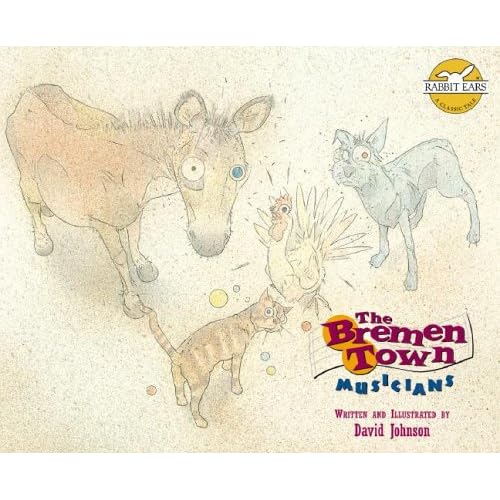
I really enjoyed the illustrations in this book. They look a little kooky as you can tell by the book cover. Their eyes are different sizes and colors and they just look so frazzled. Its no wonder their owners did not want them any longer. I couldn't find what media were used for the illustrations, but it reminded me of those blow pens I used to get when I was a kid. It was basically just a marker that was designed so you could blow one end of it and dots of color would sprinkle onto the page in no particular order. The would come with stencils and such so you could make different designs with them. It looks similar to airbrushing.

Teaching Ideas: This book would be wonderful as a music lesson. Students could be grouped together in fours (or however many the amount of students would allow) to compose their own "Bremen Town Melody" to play for the rest of the class. Each student could pick out their own instrument to play and could describe what kind of animal it would represent.
For a Language Arts lesson, students could write a short ending to the story and draw and simple picture to show what would happen if they animals in this book had continued on to Bremen Town. A bulletin board could be put together of their work to display their creative writings.